
301B Online Practice Questions and Answers
In which file would the LTM Specialist find virtual server configurations?
A. bigip.conf
B. bigip_sys.conf
C. bigip_base.conf
D. profile_base.conf
An IT administrator wants to log which server is being load balanced to by a user with IP address 10.10.10.25.
Which iRule should the LTM Specialist use to fulfill the request?
A. when SERVER_CONNECTED { if { [IP::addr [IP::remote_addr]] equals 10.10.10.25]} { log local0. "client 10.10.10.25 connected to pool member [IP::addr [LB::server addr]]" } }
B. when CLIENT_ACCEPTED { if { [IP::addr [clientside [IP::remote_addr]] equals 10.10.10.25]} { log local0. "client 10.10.10.25 connected to pool member [IP::addr [LB::server addr]]" } }
C. when SERVER_CONNECTED { if { [IP::addr [clientside [IP::remote_addr]] equals 10.10.10.25]} { log local0. "client 10.10.10.25 connected to pool member [IP::addr [LB::server addr]]" } }
D. when CLIENT_ACCEPTED { if { [IP::addr [IP::remote_addr] equals 10.10.10.25]} { log local0. "client 10.10.10.25 connected to pool member [IP::addr [LB::server addr]]" } }
A user is having issues with connectivity to an HTTPS virtual server. The virtual server is on the LTM device's external vlan, and the pools associated with the virtual server are on the internal vlan. An LTM Specialist does a tcpdump on the external interface and notices that the host header is incomplete.
In which location should the LTM Specialist put a traffic analyzer to gather the most pertinent data?
A. server
B. external VLAN
C. internal VLAN
D. client machine
An LTM Specialist has just manually failed the active LTM device over to the standby LTM device. The LTM Specialist notices the newly active LTM device is NOT currently receiving traffic. The LTM Specialist verifies the newly active device is responding to ARP but still no traffic is hitting the virtual servers. The LTM Specialist also notices that the virtual servers eventually start responding.
What should be added to the configuration to resolve the problem?
A. vlan failsafe
B. floating self IP
C. network failover
D. MAC masquerading
E. connection mirroring
-- Exhibit
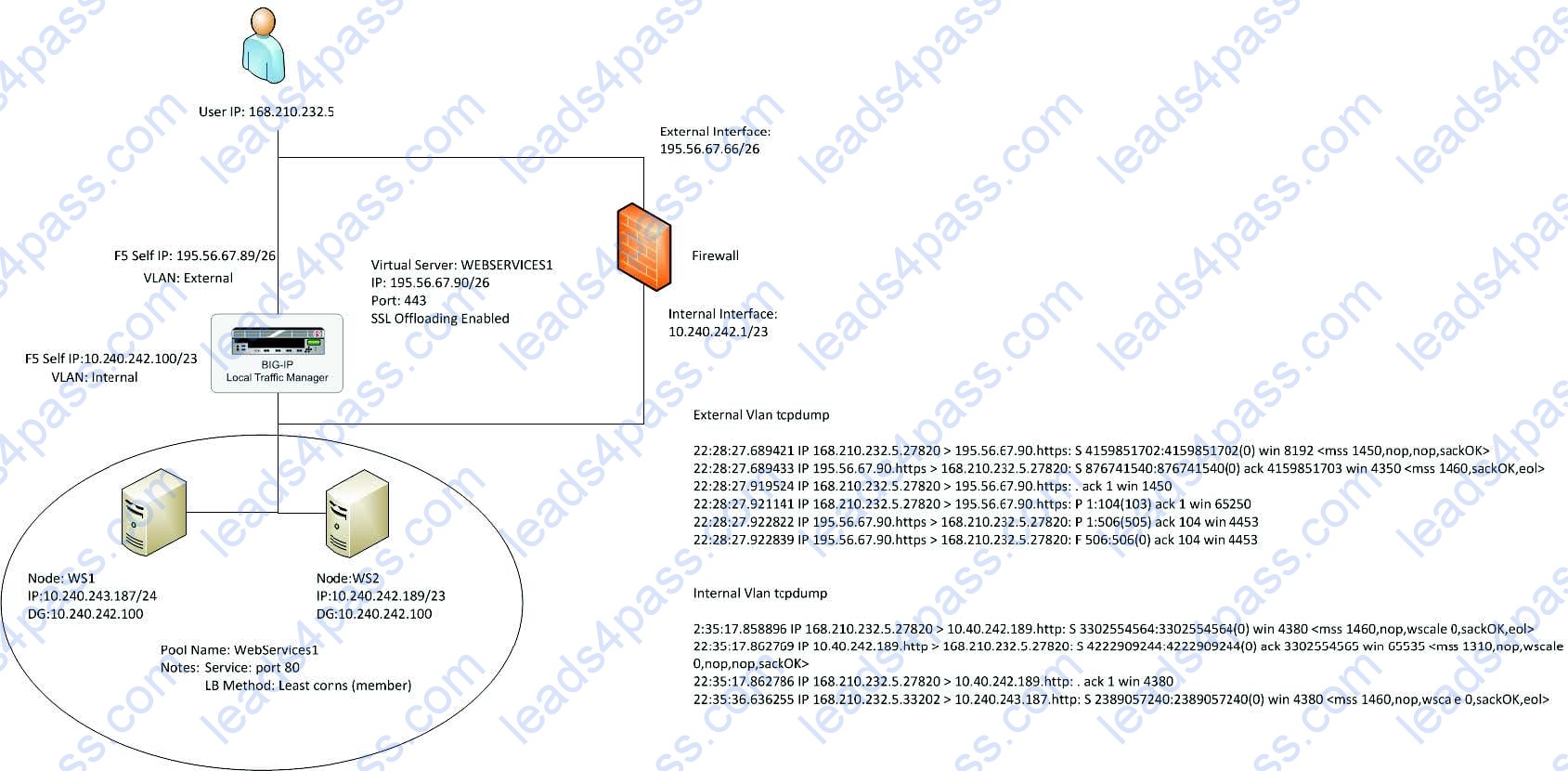
-- Exhibit -Refer to the exhibit.
An LTM Specialist has a virtual server set up on the LTM device as per the exhibit. The LTM Specialist receives reports of intermittent issues. Some clients are connecting fine while others are failing to connect.
The LTM Specialist does a tcpdump on the relevant interfaces, with the following results extracted:
What is causing the intermittent issues?
A. The firewall is dropping the packets from WS1.
B. The default gateway is inaccessible from WS1.
C. The load balancing (LB) method is inappropriate.
D. The pool members have been set up as an active/standby pair, with WS1 as the standby.
-- Exhibit
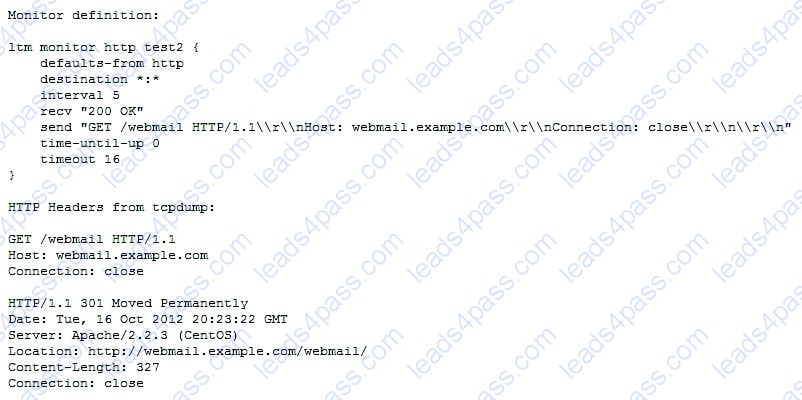
-- Exhibit -Refer to the exhibit.
An HTTP monitor always marks the nodes in the pool as down. The monitor's definition and the HTTP headers from the monitor request and response are provided.
What is the issue?
A. The response is compressed.
B. The send string is incorrect.
C. The monitor timeout is too short.
D. The monitor is NOT configured to follow the redirect.
-- Exhibit
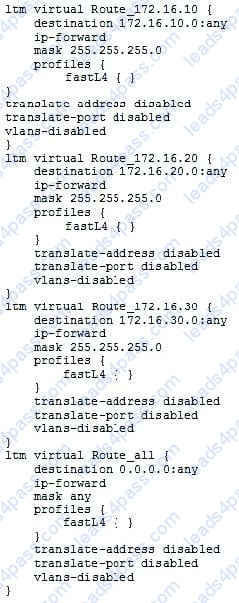
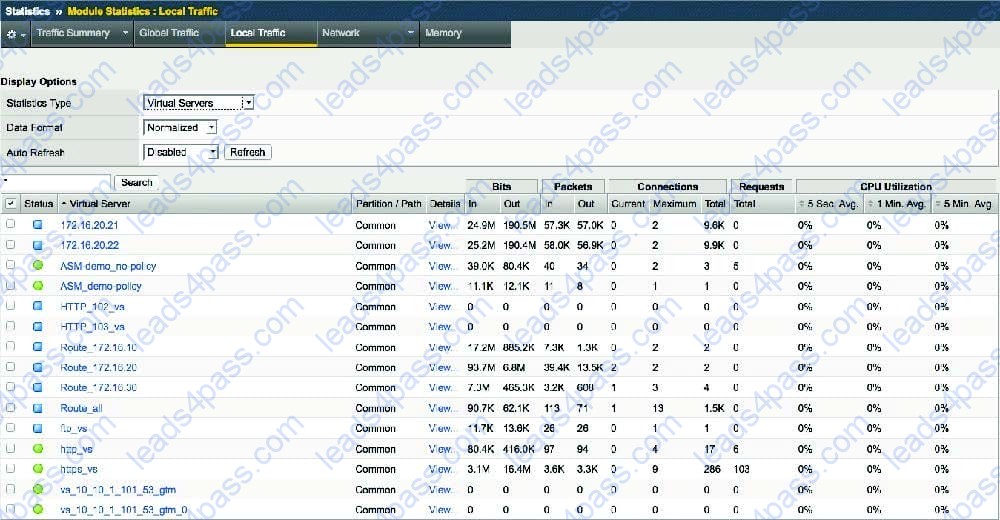
-- Exhibit -Refer to the exhibits.
An LTM device has been configured for load balancing a number of different application servers. Configuration changes need to be made to the LTM device to allow administrative management of the servers in 172.16.10/24, 172.16.20/24,
and 172.16.30/24 networks. The servers require outbound access to numerous destinations for operations.
Which solution has the simplest configuration changes while maintaining functionality and basic security?
A. Remove 172.16.10.0:0/24, 172.16.20.0:0/24, and 172.16.30.0:0/24, and keep 0.0.0.0:0/0.0.0.0 enabled on all VLANs.
B. Replace 172.16.10.0:0/24, 172.16.20.0:0/24, and 172.16.30.0:0/24, with 172.16.0.0:0/16, and keep 0.0.0.0:0/0.0.0.0.
C. Enable 172.16.10.0:0/24, 172.16.20.0:0/24, and 172.16.30.0:0/24 on ingress VLAN(s), and enable 0.0.0.0:0/0.0.0.0 on egress VLAN(s).
D. Enable 172.16.10.0:0/24, 172.16.20.0:0/24, and 172.16.30.0:0/24 on egress VLAN(s), and enable 0.0.0.0:0/0.0.0.0 on ingress VLAN(s).
-- Exhibit

-- Exhibit -
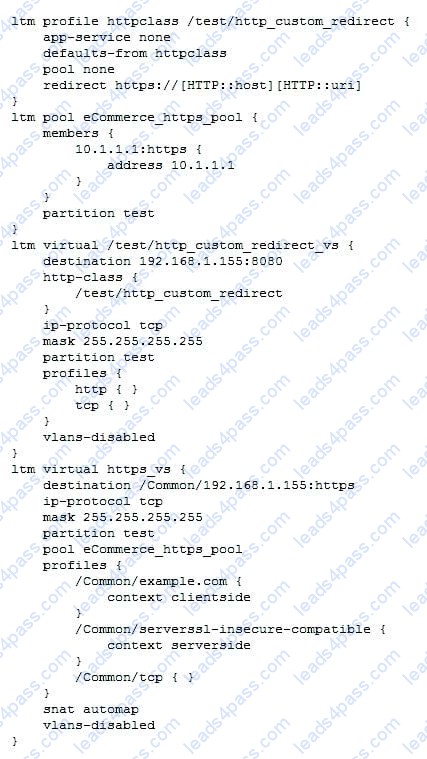
Refer to the exhibits.
An LTM Specialist is reconfiguring a virtual server to redirect all clients to HTTPS. Testing reveals that the redirect is functioning incorrectly. As part of the troubleshooting process, the LTM Specialist performs a packet capture.
What is the issue?
A. The redirect is causing an infinite loop.
B. The virtual server is missing a clientssl profile.
C. The redirect is sending the client to the incorrect location.
D. The virtual server is incorrectly processing the HTTP request.
-- Exhibit -- Exhibit -Refer to the exhibit.
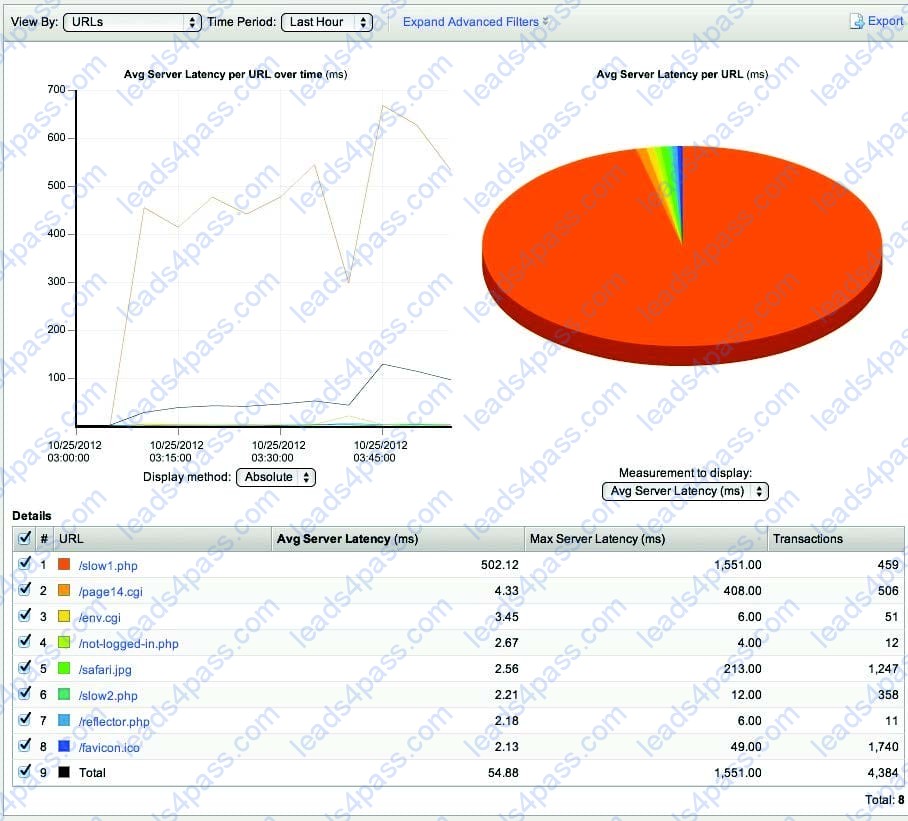
Which URL should be reported to the server/application team as getting user-visible errors?
A. /env.cgi
B. /page14.cgi
C. /reflector.php
D. /browserspecific.html
-- Exhibit
-- Exhibit -
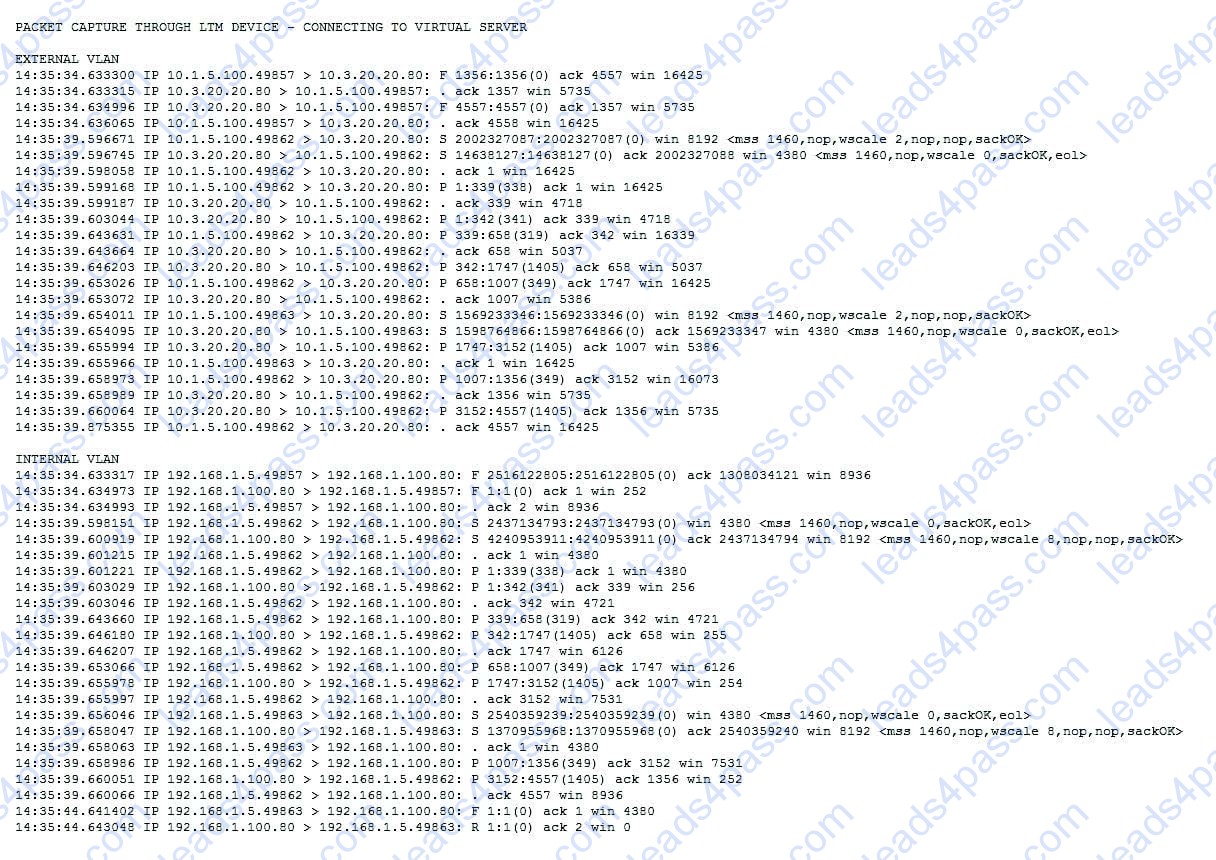
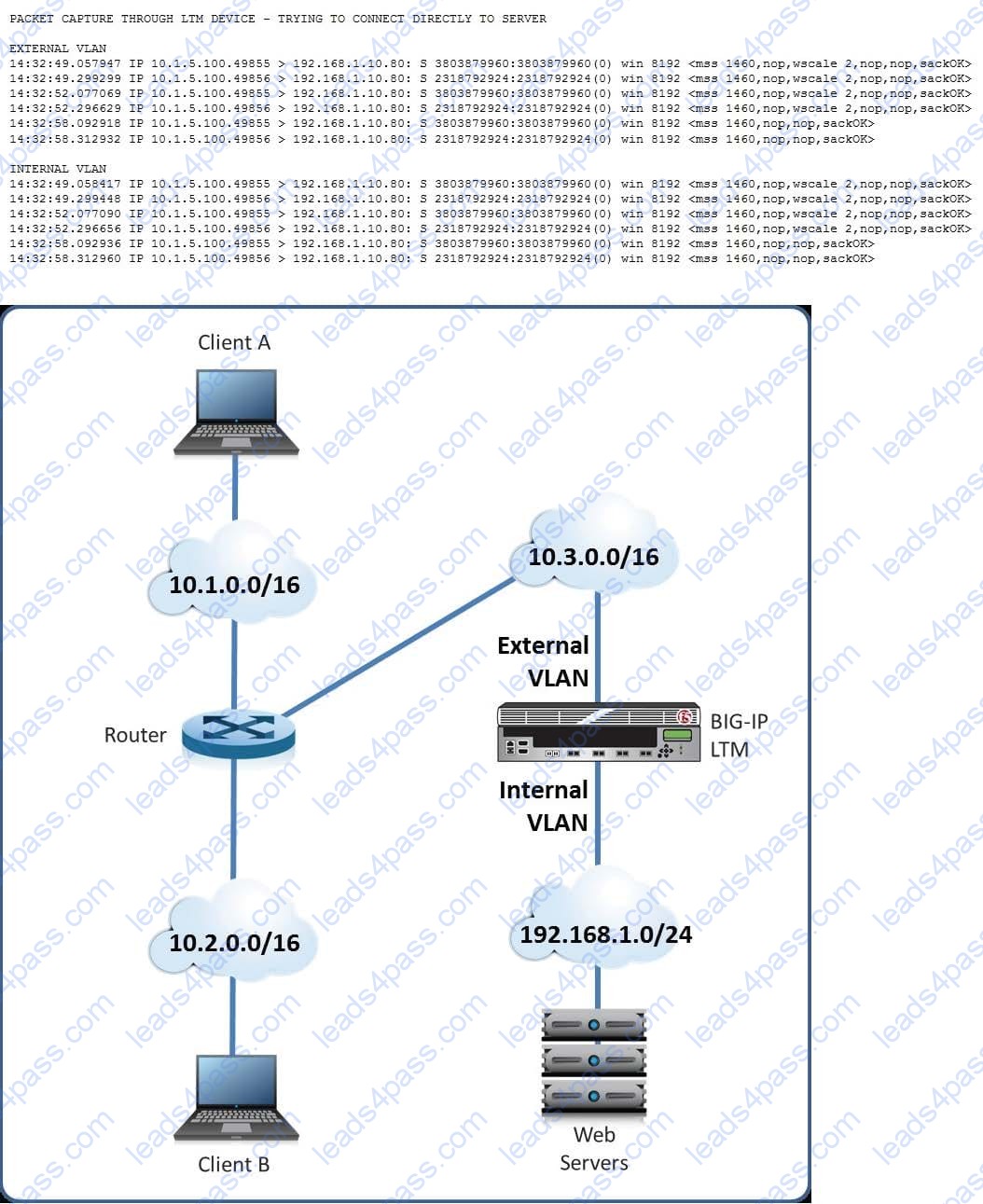
Refer to the exhibits.
Users are able to access the application when connecting to the virtual server but are unsuccessful when connecting directly to the application servers. The LTM Specialist wants to allow direct access to the application servers.
Why are users unable to connect directly to the application servers?
A. The router does NOT have a route to the server subnet.
B. The web server does NOT have a correct default gateway.
C. The LTM device does NOT have a SNAT on the External VLAN.
D. The LTM device does NOT have an IP Forwarding virtual server on the Internal VLAN.
E. The LTM device does NOT have an IP Forwarding virtual server on the External VLAN.





All rights are reserved by
leads4pass.com. Any changes, copy or trademarks abuse will be
regarded as infringement.
leads4pass.com will reserve the right to pursue accountability.
Copyright © 2004-
2026 leads4pass.com.