
1Z0-821 Online Practice Questions and Answers
The storage pool configuration on your server is:

You back up the /pool1/data file system, creating a snapshot and copying that snapshot to tape (/dev/ rmt/0). You perform a full backup on Sunday night and Incremental backups on Monday through Saturday night at 11:00 pm. Each incremental backup will copy only the data that has been modified since the Sunday backup was started.
On Thursday, at 10:00 am, you had a disk failure. You replaced the disk drive (c4t0d0). You created pool (pool1) on that disk.
Which option would you select to restore the data in the /pool1/data file system?
A. zfs create pool1/dataLoad the Monday tape and enter:zfs recv pool1/data < /dev/rmt/0Load the Wednesday tape and enter:zfs recv 璅 pool1/data < /dev/rmt/0
B. Load the Sunday tape and restore the Sunday snapshot:zfs recv pooll/data < /dev/rmt/0zfs rollback pool1/data@monLoad the Wednesday tape and restore the Wednesday snapshot:zfs recv 璱 pooll/ data < /dev/rmt/0zfs rollback pool1/data@wed
C. zfs create pooll/dataLoad the Wednesday tape and enter:zfs recv -F pool1/data < /dev/rmt/0
D. Load the Sunday tape and enter:zfs recv pool1/data < /dev/rmt/0Load the Wednesday tape and enter:* commands missing*
You need to update an OS image on a client. The pkg publishers command displays the wrong publisher with the wrong update:
PUBLISHERTYPESTATUSURI
Solaris origin onlinehttp://pkg.oracle.com/solaris/release
The update is available on the updated publisher:
PUBLISHERTYPESTATUSURI Solaris originonlinehttp://sysA.example.com
Select the option that describes the procedure used to update the OS image on the system from the updated publisher.
A. Copy the repository from the ISO image onto the local client. Configure the repository on the client by using the svccfg - s command so that the Solaris publisher is connected to the new repository. Refresh the application/pkg/server service. Issue the pkgrepo refresh command to refresh the repository catalog
B. Configure the publisher on the client using the svcfg - s command so that the Solaris publisher is connected to the repository at http://sysA.example.comRefresh the application/pkg/server service. Issue the pkgrepo refresh command to repository catalog
C. Use the pkg set-publisher command to change the URL of the publisher Solaris to http:// sysA.example.com. Issue the pkg update command to update the OS image.
D. Add the new publisher http://sysA.example.com SolarisUse the pkg set-publisher command to set the publisher search order and place http://sysA.example.com of http://pkg.oracle.com/solaris/releaseIssue the pkg publisher command to view the publishers. Set the new publisher to sticky. Issue the pkg update command to update the OS image.
ServerA contains two ISO images of a package repository named so1.repo.iso-a and so1.repo.iso-b respectively. You need to create a single local package repository on server that clients can connect to. The package repository will be stored on the /export/IPS file system and named repo. The preferred publisher will be named solaris and the publisher URL will be http://serverA.example.com.
Which is the correct procedure to perform on ServerA to create the local Package repository?
A. cat so1.repo.iso-a sol.repo.iso-b > so1.full.isoMount the ISO image and use the rsync command to extract the contents of the ISO file to the /export/IPS file system.Set the pkg/inst_root property to / export/IPS/repo and the pkg/readonly property to true.Set the preferred publisher by using pkg set-publisher -Ghttp://pkg.oracle.com/solaris/release/ \-g http"//serverA.example.com/ solaris
B. cat so1.repo.iso-a so1.repo.iso-b > /export/IPS/repoSet the pkg/inst_root property to true and the pkg/ readonly property to /export/IPSSet the preferred publisher by using pkg set-publisher -G http:// serverA.example.com/ \-g http://pkg/oracle.com/solaris/rekease/solaris
C. cat so1.repo.iso-a so1.repo.iso-b > so1.full.isoMount the ISO image and use the rsync command to extract the contents of the ISO file to /export/IPS/repoSet the pkg/inst_root property to /export/IPS/repo and the pkg/readonly property to trueSet the preferred publisher by using pkg set-publisher solaris \-g http://pkg.oracle.com/
D. cat so1.repo, iso-a so1.repo.iso-b > /export/IPS/repo.isoMount the ISO image and copy the repo directory from the ISO image to /export/IPS/reposet the pkg/inst_root property and the pkg/readonly property to /export/IPS/reposet the preferred pkg/inst_root property by using pkg set-publisher - G http://serverA.example.com/ \- g http://pkg.oracle.com/solaris.com/release/- p solaris
Identify the correctly matching pair of equivalent functionality of JumpStart and Automated installer (AI).
A. JumpStart: begin script AI: package repository
B. JumpStart: setup_serverAI: installadm create-service
C. JumpStart: add_Install_clientAI: SMF system configuration profile files
D. JumpStart: finish scripts and sysidsfg filesAI: manifest files
Which command should you choose to display the current parameters for the FSS scheduler?
A. dispadmin - c FSS
B. prionctl -c FSS
C. dispadmin -c FSS -g
D. priocntl -c FSS -g
Which two capabilities are provided by the OpenBoot PROM?
A. a command to safely shut down the system
B. hardware testing and initialization
C. booting from a disk or network
D. starting the GRUB loader
In order to display the IP addresses of network interfaces, what command would you use?
A. dladm
B. ipconfig
C. sves
D. ipadm
E. ipaddr
On which is the open boot prom available?
A. x86 only
B. x86 64-Bit only
C. SPARC only
D. both x86 and x86 64-Bit
E. x86, x86 64-Bit and SPARC
View the Exhibit to see the information taken from the installation log file.
Based on the information presented in the Exhibit, which two options describe the state of the system when the server is booted for the first time after the installation is complete?
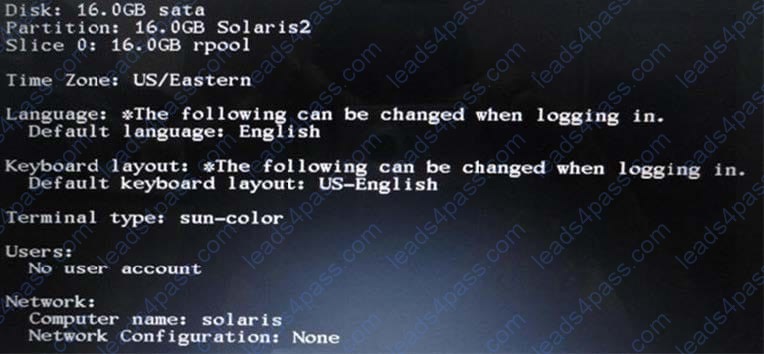
A. NWAM will be used to configure the network interface.
B. The network/physical service is offline.
C. You cannot log in from the console as root. You must first log in as a user and then su to root account.
D. The root user can log in from the console login.
E. You will be prompted to configure the network interface after the initial login.
User1 is attempting to assist user2 with terminating user2's process 1234.
User1 entered the following: kill -9 1234
Why does the process continue to run?
A. You can kill a process only if you are root.
B. You can kill only a process that you own.
C. You can kill the process only with the pkill command.
D. You need to kill the process with a stronger kill signal.





All rights are reserved by
leads4pass.com. Any changes, copy or trademarks abuse will be
regarded as infringement.
leads4pass.com will reserve the right to pursue accountability.
Copyright © 2004-
2026 leads4pass.com.