
1Z0-820 Online Practice Questions and Answers
You want to deploy Oracle Solans 11 with the Automated Installer (Al). You need to make sure that your server and network meet the requirements for using Al Choose the three options that describe the requirements for using Al. (Choose three.)
A. You must set up DHCP. The DHCP server and Al install server can be the same machine or two different machines.
B. You can create only one manifest per install service. If you need more than one manifest, create multiple install services.
C. The minimum requirement to operate as an Al install server is 1 GB of memory.
D. If two client machines have different architectures and need to be installed with the same version of the Oracle Solaris 11 OS( then create two Al manifests and a single install service.
E. Load the install/installadm package on the Al server.
Which three statements accurately describe the Automated Installation (Al) client? (Choose three.)
A. if the Al client does not match any cnteria to use a custom manifest or script, the default manifest is used.
B. if the A! client does not match any criteria to use a custom manifest or script, the automated installation aborts.
C. Any manifest or script in a service can be designated to be the default for that service.
D. Only the default.xml file is used as the default Al client manifest.
E. if a client system does not use any SC profile, then an interactive tool opens on that client at first boot after that client installation to complete the configuration of that client.
F. If a client system does not use any SC profile, then the install server will use the default SC profile.
A non-global zone named testzone is currently running.
Which option would you choose to dynamically set the CPU shares for the zone to two shares?
A. While logged in to the global zone, enter: prctl -n zone.cpu-shares -v 2 -r -i zone testzone
B. While logged in to the global zone, enter: zonecfg -z testzone add rctl set name=zone cpu-shares setvalue=(priv=privilegedJimit=2,action=none)
C. While logged in to the global zone, enter: prctl -n 2 zone cpu-shares -i zone testzone
D. While logged in to the global zone, enter: zonecfg -z testzone add rctl set name-zone cpu-shares set value=2
E. While logged in to testzone, enter: prctl -n zone.cpu-shares -v 2 -r -i zone testzone
The following information is displayed about the compress/zjp software package, which Is currently installed on this system:
NAME (PUBLISHER)VERSIONIFO
Compress/zip3.1.2-0.175.0.0.0.0.537if
NAMEVERSIONDATECOMMENT
Compress/zip3.109 Dec 2011 04:50:38 ESTNone
Which statement describes the information that is displayed tor the compress/zip software package?
A. This package cannot be removed.
B. This package can be updated to a new version when the new version of the package becomes available.
C. This package cannot be updated.
D. This package can be updated to version 3.1.3 but not 3.2.
E. This package cannot be downgraded to version 3.1.1.
You have a Solaris 10 system with a host name of sysA and it uses LDAP as a naming service. You have created a flash archive of sysA and you want to migrate this system to an Oracle Solaris 11 server as a solarislO branded zone The zone status on the Oracle Solaris 11 server is:
-zonel 0incomplete/zone/zone1solaris10 excl
Select the option that will force the non-global zone to prompt you for a host name and name service the first time it is booted.
A. Use zonecfg to change the zonename before booting the system for the first time.
B. Use the -u option with the zoneadm -z zonel 0 attach command.
C. Use the -u option with the zoneadm -z zonel 0 install command.
D. Remove the sysidcfg file from the
The crash dump notification on your server is: Documentation states that there should be two core files for each crash dump in the /var/crash directory named vmdump.0 Which command should you choose to display theses two files?
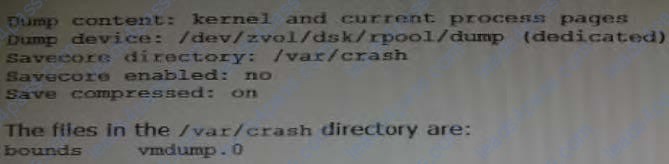
A. savecore -f vmdump.0
B. dumpadm uncompressed
C. gunzip vmdump.0
D. dumpadm -z off
You need to set up an Oracle Solaris 11 host as an iSCSI target so that the host's disk can be accessed over a storage network. The disk device is c3t4d0.
Which six options describe the steps that need to be taken on this host to enable an iSCSI target?
A. Create a ZFS file system named iscsi/target.
B. Create a zpool named iscsi with disk device c3t4d0
C. Create zfs volume named iscsi/target.
D. Use the stmfadm command to create a LUN using /dev/zvol/rdsk/iscsi/target.
E. Use the stmfadm command to create a LUN using iscsi/target.
F. Use the stmfadm command to make the LUN viewable.
G. Use the stmfadm command to make the volume viewable.
H. Enable the svc:/network/iscsi/target:default Service.
I. Use the itadm command to create the iSCSI target.
When setting up Automated Installer (Al) clients, an interactive tool can be used to generate a custom system configuration profile. The profile will specify the time zone, date and time, user and root accounts, and name services used for an Al client installation. This interactive tool will prompt you to enter the client information and an SC profile (XML file) will be created.
Which interactive tool can be used to generate this custom configuration?
A. sys-unconfig
B. installadm set-criteria
C. sysconfig create-profile
D. installadm create-profile
The COMSTAR framework provides support for the iSCSI protocol.
Identify three true statements describing the COMSTAR framework. (Choose three.)
A. One IP port can handle multiple iSCSI target devices.
B. The disk volume provided by the server is referred to as the LUN and can be accessed by an iSCSI initiator.
C. The disk volume provided by the server is referred to as the target.
D. The iSCSI initiator is configured on the server. E The iSCSI initiator is configured on the client.
View the Exhibit to inspect the file system configuration on your server.
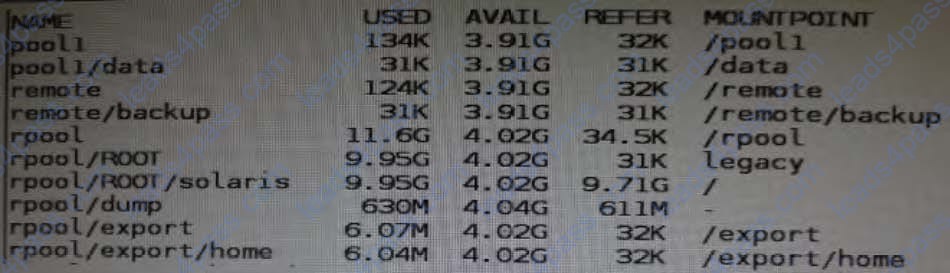
Your department's backup policy is to perform a full backup to remote system disk on Saturday.
On each weekday, you are to perform an incremental backup to the same remote system disk. Each incremental backup will contain only data that has been modified since the previous Saturday backup.
The server file systems must remain available at all times and can never be taken offline. The backup must not only provide for the recovery of the most recent version of a file, but must also allow recovery of previous versions of a file.
Following your company policy, which two describe the correct procedure to be performed on Saturday for backing tip the /data file system to a remote disk named /remote/backup?
A. On Saturday: zfs snapshot pool1/data@sat zfs send pool1/data@sat > /remote/backup/full
B. On Saturday: zfs create snapshotpool1/data@sat zfs send pool1/data@sat | zfs recv remote/backup/ `date' `+%m%d%y'
C. On Saturday: zfs create snapshotpool1/data@sat zfs send pool1/data@sat > /remote/backup/full
D. On Saturday: zfs create snapshotpool1/data@sat zfs send pool1/data@sat | zfsrecv remote/backup





All rights are reserved by
leads4pass.com. Any changes, copy or trademarks abuse will be
regarded as infringement.
leads4pass.com will reserve the right to pursue accountability.
Copyright © 2004-
2026 leads4pass.com.