
1Z0-493 Online Practice Questions and Answers
OSM is executing an order with the process indicated in the diagram. Immediately after the completion of TaskD, a revision is received, which causes only TaskB to be re-evaluated. During the re-execution of TaskB, a significant data element used by TaskA and TaskD is updated in the order. Which task is reevaluated when the compensation for TaskB completes?
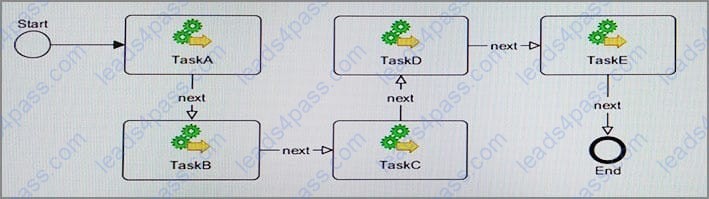
A. TaskA
B. TaskB
C. TaskC
D. TaskD
E. TaskE
In a manual task, there are three text fields configured: FIrstName, LastName, and FullName. In the FirstName and LastName fields, a Constraint Behavior is configured. In the FullName field, a Calculation Behavior is added with the following XPath expression:

While executing the manual task, a user enters values in the FirstName and LastName fields, but the FullName field is not calculated automatically. What should be done to have the FullName field automatically calculated?
A. Remove the Calculation Behavior from the FullName field and add it to either the FirstName or the LastName field.
B. Add an Event Behavior to the FirstName and LastName fields.
C. Eliminate the Constraint Behavior from the FirstName and LastName fields.
D. Remove the Constraint Behavior from the FirstName and LastName fields and add it to the FullName field.
E. Add a Relevant Behavior to the FirstName and LastName fields.
When defining a new stage of decomposition that decomposes order times by VPN site, you realize that you cannot model each site as an order component because you cannot estimate the number of sites at design time. How would you propose a solution to this situation?
A. by defining a single order component with a component ID expression that generates distinct values for distinct sites
B. by defining as many order components as it is needed to accept any possible combination of VPN sites
C. by modeling as many stages of decomposition as the number of VPN sites that you expect to handle at run time.
D. by modeling a decomposition rule with a logic that determines the target order component at run time, based on VPN site information
E. by using multi-instance order components with a pivot node that will generate at run time as many order components as the sites present in the order
Identify two mandatory properties that you must define when modeling an order item specification.
A. the property that indicates the order item name displayed on the Order Management Web client
B. the property that indicates what product specification is assigned to an order item
C. the property that indicates what product class is assigned to an order item
D. the property that indicates the delivery date requested for an order item
E. the property that stores the XML payload received when an order is created and associated with an order item
When submitting orders for testing, you notice that order items are being correctly displayed in the OSM Web client, but no order components are being generated in your orchestration plan. What would you check to find the root cause of the issue?
A. if the property that is indicated as Order Item Name Property has a valid value
B. if the property that is indicated as Product Specification Mapping Property has a valid value
C. if the task data of the Creation Task associated with the order that is being tested contains the ControlData structure
D. if the order that is submitted for testing contains at least one order item payload
E. if the XQuery expression associated with the order item property that stores the order item's XML payload has any errors
You are configuring WebLogic resources for an instance of OSM that connects to a billing application that is deployed in another WebLogic domain and that receives new messages in its local JMS queue. Which two statements are true about a possible procedure to connect OSM to this billing application?
A. You can create and use Store and Forward (SAF) resources to connect the OSM and billing queues.
B. You can configure the properties of the automation plug-in in OSM that allows connection to remote queues.
C. OSM local queues do not need any special configuration to be connected to remote queues.
D. OSM and the billing application must be deployed on the same WebLogic Server, so that OSM can write directly in the billing application queue.
E. OSM offers a productized Python script that recovers messages from the OSM local queue and inserts them in the billing application queue.
Which two systems are included with OSM within the Rapid Service Design and Order Delivery (RSDOD) solution?
A. CRM system
B. trouble ticket system
C. network discovery system
D. activation system
E. services inventory system
Which two actions would allow you to configure an XQuery automation plug-in in an automated task that is intended to publish a message in a JMS queue when the task becomes ready to be executed?
A. setting the Event Type as Internal Event Receiver
B. setting the Event Type as External Event Receiver
C. setting the Automation Type as XQuery Automator
D. setting the Automation Type as XQuery Sender
Due to internal errors in a downstream system, one of the automated tasks is receiving an error response to a request sent from OSM. Considering that the error is an issue that could be resolved by simply retrying the request, identify the functionality you would use to recover from this fallout scenario.
A. Order Change Management
B. Notifications
C. Jeopardy
D. automation framework transaction rollback E. follow-on order
In your OSM solution, you use an Oracle sealed cartridge, which contains a list of product classes with a productClassMapping.xml file to map product classes to product specifications. With the evolution of your client's product catalog, new product classes have been included and you must now update the existing XML file that is in production. What solution would you propose?
A. Unseal the existing cartridge, so that new product class entities can be added and the existing productClassMapping.xml can be updated. Redeploy the cartridge and use the updated XML file for the product class to product specification mapping.
B. Create a new cartridge, including the existing and new product classes in it, so that a new productClassMapping.xml file is generated. Deploy this cartridge and use its XML file for the product class to product specification mapping.
C. Create a new cartridge, including the new product classes in it, so that a new productClassMapping.xml file is generated. Deploy this cartridge and use both the sealed and new XML files for the product class to product specification mapping.
D. Create a new cartridge, including the new product classes in it, so that a new productClassMapping.xml file is generated. Deploy this cartridge and use its XML file for the product class to product specification mapping.
E. Update the productClassMapping.xml file manually to include the new product classes and upload it to the existing location of the old XML file. Use the new XML file for the product class to product specification mapping.





All rights are reserved by
leads4pass.com. Any changes, copy or trademarks abuse will be
regarded as infringement.
leads4pass.com will reserve the right to pursue accountability.
Copyright © 2004-
2026 leads4pass.com.