
1Z0-144 Online Practice Questions and Answers
View the Exhibit and examine the structure of the AUDIT_CUST table.
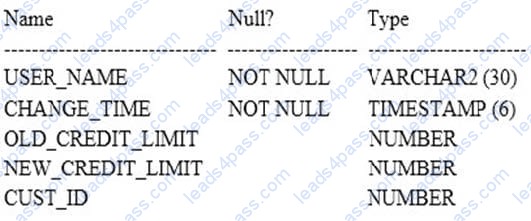
CUST_ID and CUST_CREDIT_LIMIT are existing columns in the CUSTOMER table. Examine the following trigger code:
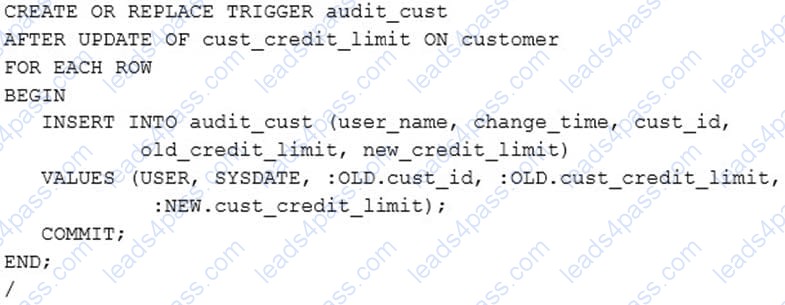
Which statement is true about the above trigger?
A. It gives an error on compilation because it should be a statement-level trigger.
B. It compiles and fires successfully when the credit limit is updated in the customer table.
C. It gives an error on compilation because of the commit command in the trigger code.
D. It compiles successfully, but gives an error when the credit limit is updated in the CUSTOMER table because the PRAGMA AUTONOMOUS_TRANSACTION statement should be introduced in the trigger.
View the Exhibit and examine the code and its outcome on execution:
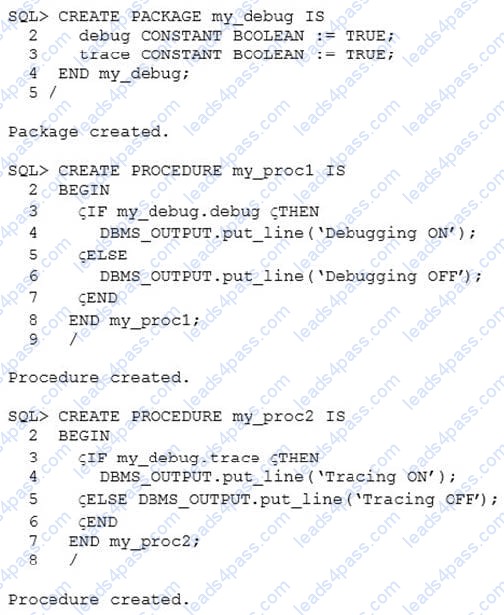
What would be the effect on the two procedures if the value of debug is set to FALSE? (Choose two.)
A. MY_PROC2 is not recompiled.
B. MY_PROC1 is recompiled but remains unchanged.
C. MY_PROC2 is recompiled but remains unchanged.
D. MY_PROC1 is recompiled without the debugging code.
Examine the following code: Which statement is true about the execution of the above code?
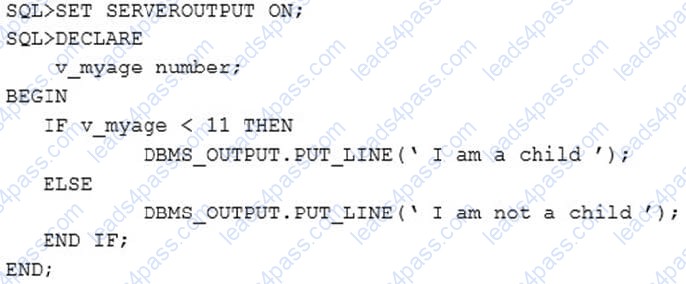
A. It executes and displays null.
B. It executes and the condition returns true.
C. It executes and control goes to the else statement.
D. It fails because no value is assigned to the v_myage variable.
Which two statements are true about the usage of the cursor for loops? (Choose two.)
A. The cursor needs to be closed after the iteration is complete.
B. The implicit open, fetch, exit, and close of the cursor happen.
C. The record type must be explicitly declared to control the loop.
D. The PL/SQL creates a record variable with the fields corresponding to the columns of the cursor result set.
Examine the following PL/SQL code: The server output is on for the session. Which statement is true about the execution of the code?
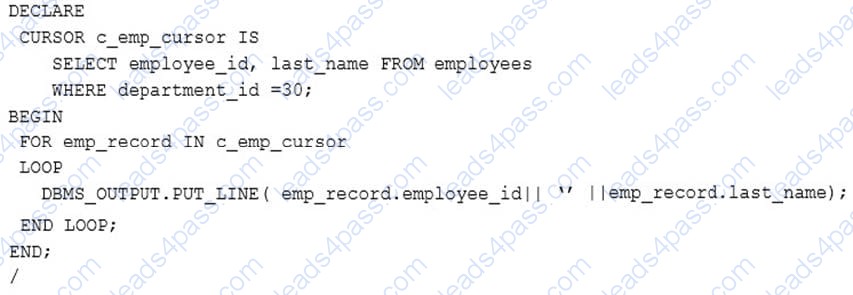
A. The code executes successfully and gives the desired output.
B. The code generates an error because the EMP_RECORD variable is not declared.
C. The code generates an error because the cursor is not opened before the FOR loop.
D. The code generates an error because the loop does not have the exit when clause.
View Exhibit 1 and examine the structure of the EMP and DEPT tables.
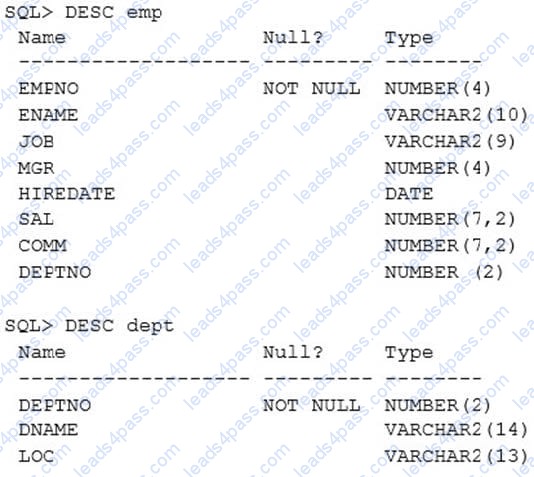
View Exhibit 2 and examine the trigger code that is defined on the DEPT table to enforce the UPDATE and DELETE RESTRICT referential actions on the primary key of the DEPT table.
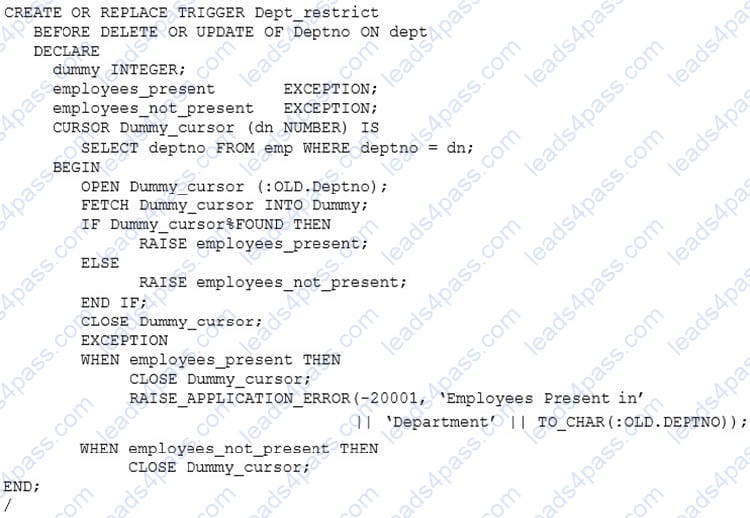
What is the outcome on compilation?
A. It compiles and executes successfully.
B. It gives an error on compilation because it is not a row-level trigger.
C. It gives an error on compilation because the EXCEPTION section is used in the trigger.
D. It compiles successfully but gives an error on execution because it is not a row-level trigger.
Examine the following block of code: Which two statements are correct about the code above? (Choose two.)
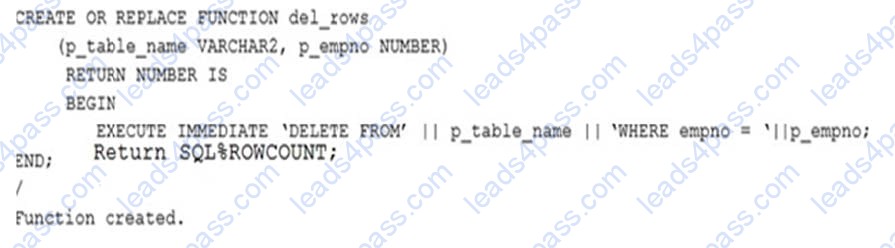
A. The function goes through only the parse and executes phases.
B. The function goes through the parse, bind, and execute phases.
C. The function goes through the parse, bind, execute, and fetch phases.
D. All the processing phases for the function are performed only at run time.
E. Only the EXECUTE IMMEDIATE statement inside the function is parsed at run time.
Examine the following package specification:
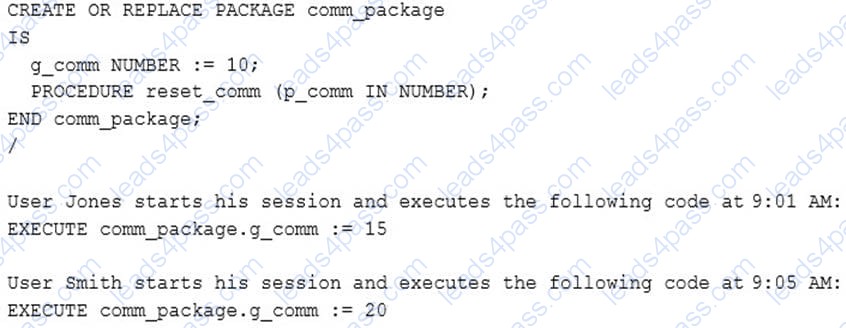
Which statement is true?
A. g_comm has a value of 15 at 9:06 AM only for Jones.
B. g_comm has a value of 10 at 9:03 AM for both Jones and Smith.
C. g_comm has a value of 15 at 9:03 AM for both Jones and Smith.
D. g_comm has a value of 20 at 9:06 AM for both Jones and Smith.
Which statements correctly describe the features of functions and procedures? (Choose two.)
A. A procedure can contain a RETURN statement without a value.
B. A function can return multiple values using a single RETURN clause.
C. A procedure can be executed as part of a SQL expression or as a PL/SQL statement.
D. A function can contain zero or more parameters that are transferred from the calling environment.
View the Exhibit and examine the structure of the CUSTOMER table.
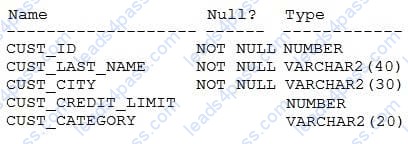
You need to create a trigger to ensure that customers in category "A" and "B" have a credit limit of more than 8000.
Examine the following trigger.
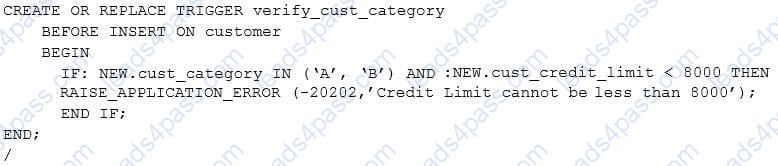
Which statement is correct about the outcome of this trigger?
A. It compiles successfully and fires whenever the specified condition is met.
B. It compiles successfully but does not fire even when the condition is met.
C. It gives an error on compilation because the NEW qualifier is prefixed with a colon.
D. It gives an error on compilation because the NEW qualifier can be used only in row-level triggers.





All rights are reserved by
leads4pass.com. Any changes, copy or trademarks abuse will be
regarded as infringement.
leads4pass.com will reserve the right to pursue accountability.
Copyright © 2004-
2026 leads4pass.com.