
1Z0-117 Online Practice Questions and Answers
Which three statements are true about histograms?
A. They capture the distribution of different values in an index for better selectivity estimates.
B. They can be used only with indexed columns.
C. They provide metadata about distribution of and occurrences of values in a table column.
D. They provide improved selectivity estimates in the presence of data skew, resulting in execution plans with uniform distribution.
E. They help the optimizer in deciding whether to use an index or a full table scan.
F. They help the optimizer to determine the fastest table join order.
Which two statements about In-Memory Parallel Execution are true?
A. It can be configured using the Database Resource Manager.
B. It increases the number of duplicate block images in the global buffer cache.
C. It requires setting PARALLEL_DEGREE_POLICY to LIMITED.
D. Objects selected for In-Memory Parallel Execution have blocks mapped to specific RAC instances.
E. It requires setting PARALLEL_DEGREE_POLICY to AUTO
F. Objects selected for In-Memory Parallel Execution must be partitioned tables or indexes.
You are logged in as the HR user and you execute the following procedure:
SQL > exec DBMS_STATS.SET_TABLE_PREFS (`HR', `EMPLOYEES', `PUBLISH', `FALSE'); SQL> exec DBMS_STATS.GATHER_TABLE_STATS (`HR', `EMPLOYEES');
Which statement is true about the newly gathered statistics?
A. They are temporary and purged when the session exits.
B. They are used by the optimizer for all sessions.
C. They are locked and cannot be overwritten.
D. They are marked as pending and stored in the pending statistics table.
You execute the following query:
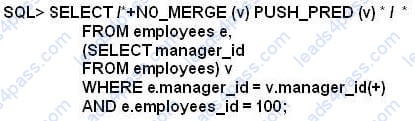
Which statement is true about the usage of these hints in the query?
A. The optimizer pushes the join predicate into the inline view.
B. The optimizer evaluates the subquery as a first and then filters out rows.
C. The optimizer performs a join operation first and then filters out the rows.
D. The hint will have no effect because one of the join resultsets is an inline view.
Which three statements are true the Automatic Tuning Optimizer (ATO)?
A. It identifies the objects with stale or missing statistics and gathers statistics automatically.
B. It investigates the effect of new or modified indexes on the access paths for a workload and recommends running that statistics through the SQL Access Advisor.
C. It recommends a SQL profile to help create a better execution plan.
D. It picks up resource-intensive SQL statements from the ADDM and recommends the use of materialized views to improve query performance.
E. It identifies the syntactic, semantic, or design problems with structure of SQL statements leading to poor performance and suggests restricting the statements.
F. It identifies resource-intensive SQL statements, runs them through the SQL Tuning Advisor, and implements the recommendations automatically.
Examine the query and its execution plan: Which two statements are true regarding the execution plan?
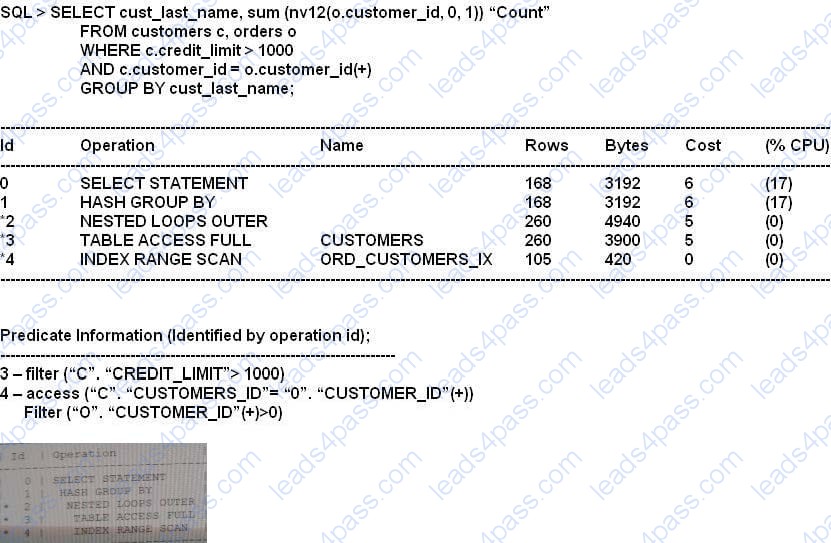
A. For every row of CUSTOMERS table, the row matching the join predicate from the ORDERS table are returned.
B. An outer join returns NULL for the ORDERS table columns along with the CUSTOMERS table rows when it does not find any corresponding rows in the ORDER table.
C. The data is aggregated from the ORDERS table before joining to CUSTOMERS.
D. The NESTED LOOP OUTER join is performed because the OPTIMZER_MODE parameter is set to ALL_ROWS.
How can you analyze an existing trace file to list the almost resource-intensive statements, aggregation of statistics, and to either exclude recursive call details?
A. By using the DBMS_TRACE package
B. By using the EXPLAIN PLAN command
C. By enabling the SQL_TRACE parameter for the session
D. By using the TKPROF utility
E. By using the TRCSESS utility
See the code fragment:
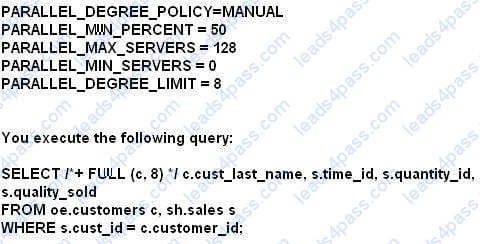
You receive the following error message:
ORA-12827: insufficient parallel query slaves available
Which three parameter settings could you change to avoid this error?
A. Decrease the value of PARALLEL_MIN_PERCENT
B. Increase the value of PARALLEL_MAX_SERVERS
C. Increase the value of PARALLEL_MIN_SERVERS
D. Reduce the value of PARALLEL_MIN_TIME_THRESHOLF
E. Increase the value of PARALLEL_DEGREE_LIMIT
F. Set the PARALLEL_DEGREE_POLICY = AUTO
G. Set the PARALLEL_DEGREE_POLICY = LIMITED
Partial details of an execution plan.
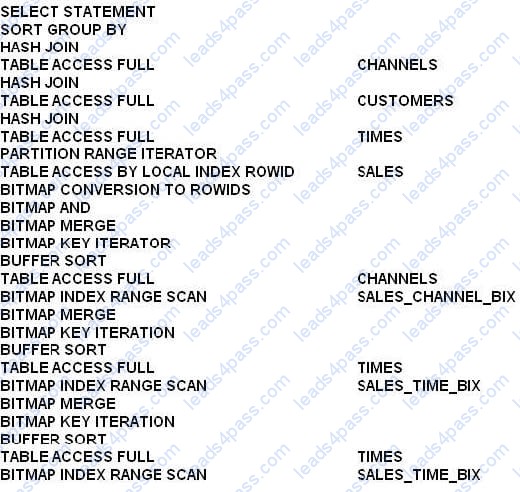
Which statement correctly describes the BITMAP AND operation?
A. It produces a bitmap, representing dimension table rows from all dimension tables that join with qualified fact table rows.
B. It produces a concentration of the bitmaps for all dimension tables.
C. It produces a bitmap, representing fact table rows that do not join with qualified dimension table rows from all dimension tables.
D. It produces a bitmap, representing fact table rows that join with qualified dimension table rows from all dimension tables.
You recently gathered statistics for a table by using the following commands:

You noticed that the performance of queries has degraded after gathering statistics. You want to use the old statistics. The optimizer statistics retention period is
default.
What must you do to use the old statistics?
A. Use the flashback to bring back the statistics to the desired time.
B. Restore statistics from statistics history up to the desired time.
C. Delete all the statistics collected after the desired time.
D. Set OPTIMIZER_USE_PENDING_STATISTICS to TRUE.





All rights are reserved by
leads4pass.com. Any changes, copy or trademarks abuse will be
regarded as infringement.
leads4pass.com will reserve the right to pursue accountability.
Copyright © 2004-
2026 leads4pass.com.