
1Z0-1082-21 Online Practice Questions and Answers
Which Is NOT a key quality of the Models Interface In Profitability and Cost Management?
A. Setting up the flow of funds through the financial system
B. Managing and running reports
C. Managing rules and rule sets
D. Point and click model administration and calculation
Which two statements are true about model validation?
A. You cannot deploy the application if model validation returns Invalid conditions.
B. Model validation validates rules, rule sets, and dimensions.
C. Running a model validation displays an error table with Information about Invalid conditions.
D. After the application is deployed, it can detect invalid model artifacts if changes are made to dimensions.
Which three are steps to create an allocation rule?
A. populate the driver basis dimensions
B. select the execution method
C. populate the allocation formula
D. populate the destination dimensions
E. populate the source dimensions
Which two are required steps In creating an allocation rule?
A. Assign the rule sequence number,
B. Create at least one global context.
C. Create a rule set for the rule.
D. Create a rule set context.
Which two system level settings are not also user level settings In Data Management?
A. Global POV profile settings
B. the level of detail displayed In logs
C. File character set
D. The column delimiter value when exporting member mappings
E. Whether archived files are copied or moved to the archive location
Assume the computer hardware supports parallel calculation. Given these two rule sets, in what order will the rules be calculated?
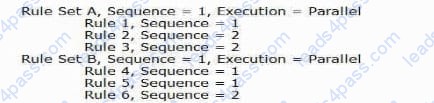
A. Rule 1, Rule A, and Rule 5 will run In parallel; then Rule 2, Rule, 3, and Rule 6 will run in parallel (two separate calculation steps).
B. Rule 1; then Rule 2 and Rule 3 will run in parallel; then Rule 4 and Rule 5 will run in parallel; then Rule 6 (four separate calculation steps).
C. Rule 1, Rule A, and Rule 5 will run in parallel while Rule 2, Rule 3, and Rule 6 also run in parallel (one calculation step).
D. Rule 1; then Rule 4 and Rule 5 will run in parallel; then Rule 2 and Rule 3 will run in parallel; then Rule 6 (four separate calculation steps).
Which three statements are valid about data load mappings In Data Management?
A. Data Management processes mappings from left to right with Explicit processed first.
B. Special characters * and ? can only be used in the Source Value expression.
C. Mappings can be imported from Excel.
D. Data load mapping definitions for every dimension are required In Data Load Mappings except for Period and Category.
E. If the source member matches the target member exactly, no mapping definition Is required for that dimension.
Given the following possible actions:
1.
Register a Source System
2.
Register a Target Application
3.
Create an Import Format
4.
Define a Location
5.
Create a Point of View
6.
Define mappings for Period and Category
7.
Define mappings for all dimensions
8.
Define mappings for only those dimensions requiring mappings
9.
Create a Data Load Rule
What are the required steps in Data Management to create a data Integration for Profitability and Cost Management?
A. 1,2,3,4,8,0
B. 1,2,3,4,5,6,7,9
C. 1,2,3,4,5,6,8,9
D. 1,2,3,4,6,8,9
E. 1,2,3,4,6,7,9
Which three are valid statements about batch processing in Data Management?
A. Batches can be executed from EPM Automate.
B. Service Administrators can configure security to limit which batches users can run.
C. Batch processing combines one or more data load rules In a batch so you can run multiple data load rules In one step.
D. Batch processing combines one or more dimension builds In a batch so you can run multiple dimension builds in one step.
E. Batch processing does not support parallel loading of data files.
For which two of these purposes can you use model views?
A. To create analysis views for specific slices of data
B. To assign data grants to specific slices of data
C. To filter the results when tracing allocations or performing rule balancing
D. When mass editing rules, to limit the edits to a subset of the data
E. When copying POVs, to limit the copy to a subset of the data





All rights are reserved by
leads4pass.com. Any changes, copy or trademarks abuse will be
regarded as infringement.
leads4pass.com will reserve the right to pursue accountability.
Copyright © 2004-
2026 leads4pass.com.