
1Z0-1082-20 Online Practice Questions and Answers
Which set of dimensions Is required for Profitability and Cost Management applications?
A. Two system dimensions (Balance and Rule), at least one Business dimension, at least one POV dimension
B. Three system dimensions (Balance, Rule, and Drivers), at least two Business dimensions, at least one POV dimension
C. Three system dimensions (Balance, Rule, and Drivers), at least one Business dimension, at least one POV dimension
D. Two system dimensions (Balance and Rule), at least one Business dimension, at least one POV dimension, at least one Attribute dimension, at least one Alias dimension
E. Two system dimensions (Balance and Rule), at least one Business dimension, at least one POV dimension, at least one Alias dimension
Which types of dimensions do you use to define model views?
A. Business dimensions only
B. Business dimensions, POV dimensions
C. Business dimensions, POV dimensions. System dimensions
D. POV dimensions. System dimensions
Which three are valid functions of logic accounts In Data Management?
A. Logic accounts allow the mapping of a source account based on its value (conditional mapping).
B. Logic accounts can perform arithmetic operations on source values (arithmetic mapping).
C. Logic accounts determine how the source fields are stored In the Data Management staging tables (storing mapping).
D. Simple logic groups enable you to derive logic items front any combination of dimensions (derived mapping).
E. Logic accounts allow the mapping of one source account to multiple target accounts (statistical mapping).
Which dimension Is required for a Profit Curve chart In the application?
A. Point of View Dimensions
B. Department Dimension
C. Profit Dimension
D. Profit Attribute Dimension
After running a calculation, you are evaluating the results In the Rule Balancing screen. What can you do to Investigate the data In more detail?
A. Click on either Allocation in or Allocation Out to open an Allocation Trace.
B. Click on a value to drill down to more detail in the Rule Balancing screen.
C. Click on a rule number to open a report showing the entire allocation flow.
D. Click on a value to open a context sensitive query in Smart View.
You are creating a rule to allocate IT costs to entitles based on the Headcount for each entity. There are
three business dimensions In the application (Product, Entity, and Account).
The allocation source definition:
Account: IT Cost; Product: NoProduct; Entity: Corporate HQ
The allocation destination definition:
Account: IT Cost; Product: NoProduct; Entity: Descendants of Entity
Disregarding the system and POV dimensions, this data file shows where Headcount data is loaded in the
application:
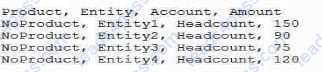
Which business dimension members should you select for the driver location on the Driver Basis tab when you define the allocation rule?
A. NoProduct, Headcount
B. Headcount
C. Entity1, Entity2, Entity3, Entity4
D. NoProduct, Corporate HQ, Headcount
What are two ways to create custom reports on the data In Profitability and Cost Management?
A. Import report templates from the Download link in the Settings menu and customize them for your application.
B. Create forms In Profitability and Cost Management that can be displayed in dashboards.
C. Create queries In Profitability and Cost Management that open in Smart View when you run them.
D. Create formatted reports in Financial Reporting Web Studio.
Assume the computer hardware supports parallel calculation. Given these two rule sets, in what order will the rules be calculated?
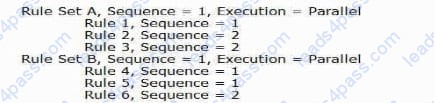
A. Rule 1, Rule A, and Rule 5 will run In parallel; then Rule 2, Rule, 3, and Rule 6 will run in parallel (two separate calculation steps).
B. Rule 1; then Rule 2 and Rule 3 will run in parallel; then Rule 4 and Rule 5 will run in parallel; then Rule 6 (four separate calculation steps).
C. Rule 1, Rule A, and Rule 5 will run in parallel while Rule 2, Rule 3, and Rule 6 also run in parallel (one calculation step).
D. Rule 1; then Rule 4 and Rule 5 will run in parallel; then Rule 2 and Rule 3 will run in parallel; then Rule 6 (four separate calculation steps).
Which three are valid statements about Locations In Data Management?
A. A location can be assigned to more than one data load rules.
B. A location can be assigned to more than one Import format.
C. You can create duplicate locations with the same source system and application combination.
D. Different locations can use the same import format.
E. A location may have more than one source system.
Which statement Is FALSE about Analysis Views?
A. They can be viewed by any user of the application.
B. You canadd formatting to the report results.
C. You can export their data to Excel for further processing.
D. You can use them as the basis for dashboards.





All rights are reserved by
leads4pass.com. Any changes, copy or trademarks abuse will be
regarded as infringement.
leads4pass.com will reserve the right to pursue accountability.
Copyright © 2004-
2026 leads4pass.com.