
1Z0-1067-21 Online Practice Questions and Answers
You have created an Autonomous Data Warehouse (ADW) service in your company's Oracle Cloud Infrastructure (OCI) tenancy and you now have to load historical data into it. You have already extracted this historical data from multiple data marts and data warehouses. This data is stored in multiple CSV text files and these files are ranging in size from 25 MB to 20 GB.
Which is the most efficient and error tolerant method for loading data into ADW? (Choose the best answer.)
A. Create Auth token, use it to create an object storage credential by executing DBMS_CLOUD.CREATE_CREDENTIAL, using the web console upload the CSV files to an OCI object storage bucket, create the tables in the ADW database and then execute DBMS_CLOUD.COPY_DATA for each CSV file to copy the contents into the corresponding ADW database table.
B. Create the tables in the ADW database and then execute SQL*Loader for each CSV file to load the contents into the corresponding ADW database table.
C. Create Auth token, use it to create an object storage credential by executing DBMS_CLOUD.CREATE_CREDENTIAL, using OCI CLI upload the CSV files to an OCI object storage bucket, create the tables in the ADW database and then execute Data Pump Import for each CSV file to copy the contents into the corresponding ADW database table.
D. Create Auth token, use it to create an object storage credential by executing DBMS_CLOUD.CREATE_CREDENTIAL, using OCI CLI upload the CSV files to an OCI object storage bucket, create the tables in the ADW database and then execute DBMS_CLOUD.COPY_DATA for each CSV file to copy the contents into the corresponding ADW database table.
You have received an email from your manager to provision new resources on Oracle Cloud Infrastructure (OCI). When researching OCI, you determined that you should use OCI Resource Manager. Since this is a task that will be done multiple times for development, test, and production. You will need to create a command that can be re-used.
Which CLI command can be used in this situation? (Choose the best answer.)
A. oci resource-manager stack create ––tenancy–id
B. oci resource-manager stack update ––compartment–id
C. oci resource-manager stack create ––compartment–id
D. oci resource-manager stack update ––tenancy–id
Which two statements about the Oracle Cloud Infrastructure (OCI) Command Line Interface (CLI) are TRUE? (Choose two.)
A. You can run CLI commands from inside OCI Regions only.
B. You can filter CLI output using the JMESPath query option for JSON.
C. The CLI provides an automatic way to connect with instances provisioned on OCI.
D. The CLI allows you to use the Python language to interact with OCI APIs.
E. The CLI provides the same core functionality as the Console, plus additional commands.
Your customer is running a set of compute instances inside a private subnet to manage their workloads on Oracle Cloud Infrastructure (OCI) tenancy. You have set up auto scaling feature to provide consistent performance to their end users during period of high demand.
Which step should be met for auto scaling to work? (Choose the best answer.)
A. OS Management Service agent (osms) must be installed on the instances.
B. Audit logs for the instances should be enabled.
C. Service gateway should be setup to allow instances to send metrics to monitoring service.
D. Monitoring for the instances should not be enabled.
You have recently joined a startup company and quickly find that nobody is tracking the amount of money spent on Oracle Cloud Infrastructure (OCI). Seeing an opportunity to help save money you begin creating a solution to better track the cost of resources provisioned by each individual on the team.
Which option allows you to identify excessive spend across all resources in your tenancy? (Choose the best answer.)
A. Use the Python SDK to write a custom application that will monitor the Audit log. Look for CREATE events and configure the application to send you an email each time a new resource is created.
B. Create a tag namespace named BILLING with a Tag Key named CostCenter. Tag each of your resources with this Tag Key and the correct value.
C. Use the Events Service and create rules that will act when a new Object Storage bucket or Compute Instance has been created. Have the rule email you each time one of these events occurs.
D. Create a budget for each compartment that will send a notification when monthly spend reaches a predefined amount.
Multiple teams are sharing a tenancy in Oracle Cloud Infrastructure (OCI). You are asked to figure out an appropriate method to manage OCI costs.
Which is NOT a valid technique to accurately attribute costs to resources used by each team? (Choose the best answer.)
A. Create a Cost-Tracking tag. Apply this tag to all resources with team information. Use the OCI cost analysis tools to filter costs by tags.
B. Create separate compartment for each team. Use the OCI cost analysis tools to filter costs by compartment.
C. Create an Identity and Access Management (IAM) group for each team. Create an OCI budget for each group to track spending.
D. Define and use tags for resources used by each team. Analyze usage data from the OCI Usage Report which has detailed information about resources and tags.
Your deployment platform within Oracle Cloud Infrastructure (OCI) leverages a compute instance with multiple block volumes attached. There are multiple teams that use the same compute instance and have access to these block volumes. You want to ensure that no one accidentally deletes any of these block volumes. You have started to construct the following IAM policy but need to determine which permissions should be used.
allow group DeploymentUsers to manage volume-family where ANY { request.permission != , request.permission != , request.permission != }
Which permissions can you use in place of in this policy? (Choose the best answer.)
A. VOLUME_DELETE, VOLUME_ATTACHMENT_DELETE, VOLUME_BACKUP_DELETE
B. VOLUME_ERASE, VOLUME_ATTACHMENT_ERASE, VOLUME_BACKUP_ERASE
C. ERASE_VOLUME, ERASE_VOLUME_ATTACHMENT, ERASE_VOLUME_BACKUP
D. DELETE_VOLUME, DELETE_VOLUME_ATTACHMENT, DELETE_VOLUME_BACKUP
You have a group pf developers who launch multiple VM.Standard2.2 compute instances every day into the compartment Dev. As a result, your OCI tenancy quickly hit the service limit for this shape. Other groups can no longer create new instances using VM.Standard2.2 shape.
Because of this, your company has issued a new mandate that the Dev compartment must include a quota to allow for use of only 20 VM.Standard2.2 shapes per Availability Domain. Your solution should not affect any other compartment in the tenancy.
Which quota statement should be used to implement this new requirement? (Choose the best answer.)
A. set compute quota vm-standard2–2count to 10 in compartment dev where request.region = usphoenix–1
B. set compute quota vm-standard2–2–count to 20 in compartment dev
C. zero compute quotas in tenancy set compute quota vm–standard2–2–count to 20 in compartment dev
D. zero compute quotas in tenancy set compute quota vm–standard2–2–count to 20 in tenancy dev
You set up a bastion host in your VCN to only allow your IP address (140.19.2.140) to establish SSH connections to your Compute Instances that are deployed in a private subnet. The Compute Instances have an attached Network Security Group with a Source Type: Network Security Group (NSG), Source NSG: NSG-050504. To secure the bastion host, you added the following ingress rules to its Network Security Group:
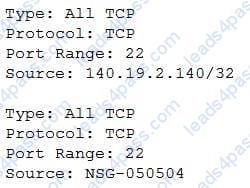
However, after checking the bastion host logs, you discovered that there are IP addresses other than your own that can access your bastion host.
What is the root cause of this issue? (Choose the best answer.)
A. The Security List allows access to all IP address which overrides the Network Security Group ingress rules.
B. All compute instances associated with NSG-050504 are also able to connect to the bastion host.
C. The port 22 provides unrestricted access to 140.19.2.140 and to other IP address.
D. A netmask of /32 allows all IP address in the 140.19.2.0 network, other than your IP 140.19.2.140
You are asked to implement the disaster recovery (DR) and business continuity requirements for Oracle Cloud Infrastructure (OCI) Block Volumes. Two OCI regions being used: a primary/source region and a DR/destination region. The requirements are:
There should be a copy of data in the destination region to use if a region-wide disaster occurs in the source region Minimize costs
Which design will help you meet these requirements? (Choose the best answer.)
A. Clone block volumes. Use Object Storage lifecycle management to automatically move clone objects to Archive Storage. Copy Archive Storage buckets from source region to destination at regular intervals.
B. Clone block volumes. Copy block volume clones from source region to destination region at regular intervals.
C. Back up block volumes. Copy block volume backups from source region to destination region at regular intervals.
D. Back up block volumes. Use Object Storage lifecycle management to automatically move backup objects to Archive Storage. Copy Archive Storage buckets from source region to destination at regular intervals.





All rights are reserved by
leads4pass.com. Any changes, copy or trademarks abuse will be
regarded as infringement.
leads4pass.com will reserve the right to pursue accountability.
Copyright © 2004-
2026 leads4pass.com.