
1Z0-1058-20 Online Practice Questions and Answers
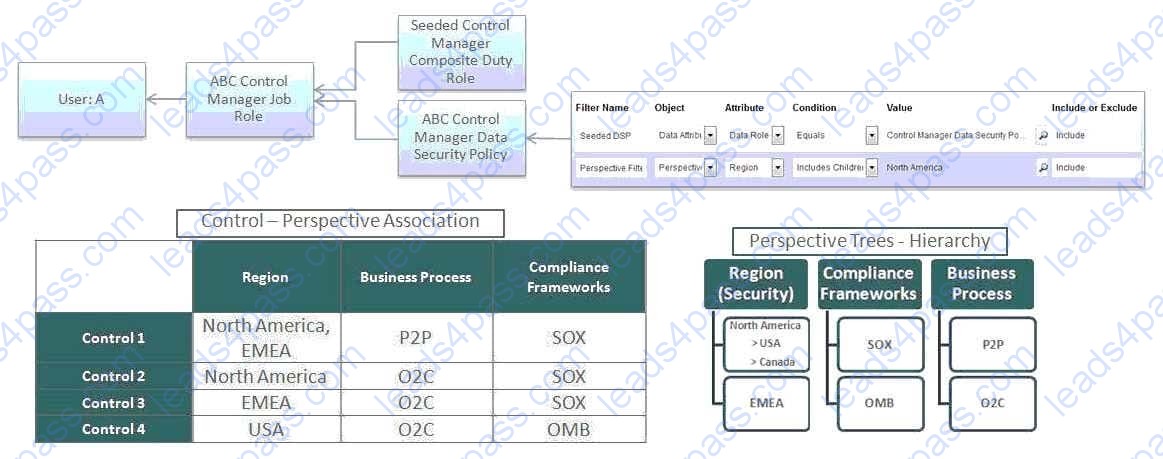
Which controls can user A manage for the following Control Manager role Configuration? See details of perspective trees and control-perspective association below.
A. All controls
B. Controls 2 and 4
C. Controls 1, 2, and 4
D. None
E. Controls 1 and 2
The internal auditor advised the Control Owner of North America to perform assessment for two P2P
controls.
Which three steps can the Control Owner perform to kick-off assessments for only those two controls?
(Choose three.)
A. Initiate a planned assessment that includes all controls assigned to perspective P2P.
B. Perform impromptu assessments for the two controls.
C. Enable impromptu assessments during configuration of module objects.
D. Initiate a planned assessment and include the two controls as part of the same assessment.
E. Initiate two planned assessments, one for each control.
You are advising your client on design and configuration related to how access incident results will be viewed and managed. The client has provided a list of business requirements: Incident results can be viewed by Department Groups of investigators receive assigned incidents based on Department Must ensure systematically that no incident is unassigned to an investigator
Which three must be configured to support these requirements? (Choose three.)
A. Worklist assignment Result Investigator should be set to specific users.
B. Custom perspective for Department linked to the Results object with Required set to "No"
C. Custom perspective for Department linked to the Results object with Required set to "Yes"
D. Investigators are assigned job roles with custom Department perspective data roles attached. Other incident users receive job roles which only allow viewing of incidents.
E. Investigators are assigned job roles with custom Department perspective data roles attached for managing incidents. Other incident users are assigned job roles with custom Department perspective data roles attached for viewing only.
F. Worklist assignment Result Investigator should be set to "All Eligible Users"
You are implementing Advanced Financial Controls and you want to identify suspect transactions where the payment amount is less than $20 USD. However, you only want the results returned to be temporary. What will you build in order to accomplish your objective?
A. Template
B. Control
C. Model
D. Filter
E. Business object
You are gathering requirements on how your client performs control assessments. Which three tasks should you complete to set up assessments in Financial Reporting Compliance? (Choose three.)
A. Identify the type of assessments included in each assessment cycle.
B. Understand the sample size for each audit test.
C. Determine if control assessments are planned ahead of time or are run impromptu.
D. Determine the main objectives of deploying the control.
E. Determine whether assessments templates, plans, and completed assessments need to go through a review and approve workflow.
You are configuring security and you do not want the risks to go through the review and approve process each time they are updated. How will you meet this requirement?
A. Add the Risk Reviewer Composite duty role to the person who creates the risks so he or she would be able to review them before saving the record.
B. Use only the Risk Approver Composite duty role in the configurations so the risks will not go through the review process.
C. Ensure that only the upper management is given the Risk Reviewer Composite duty role so they could review the risks that they want to review.
D. Ensure that no user has been assigned a job role that includes the Risk Reviewer Composite or Risk Approver Composite Duty Role.
Your client has subscribed to Financial Reporting Compliance and would like to address risks using
treatment plans.
Which option shows the settings that will help in achieving this configuration?
A. Configure Module Perspectives > Edit Financial Reporting Compliance > Risk-Organization mapping set to required, active.
B. Configure Module Objects > Edit Risk Object Configuration > Treatment = Show
C. Configure Module Objects > Edit Risk Object Configuration > Treatment = Hide and Default
D. Configure Module Objects > Edit Control Object Configuration > Result = Show
E. Configure Module Objects > Edit Risk Object Configuration > Result = Show
You can relate objects in Financial Reporting Compliance. Which statement is true about editing or creating related objects in the Related Objects section on the Risk Definition page?
A. You can relate only process objects.
B. You can relate a new process and a new control.
C. You can relate only control objects.
D. You can relate only an existing control, but not a new control.
You have scheduled quarterly assessments for a Control object at the beginning of the year with future dates. However, the test plans associated with the Control object were updated before the assessment could be started. Which statement is true about this scenario?
A. The user will have the option to select the older or newer versions of the test plans during the assessment process.
B. The scheduled assessment process will end in error.
C. The assessment will be associated with the version of the test plans from the time of assessment initiation.
D. The updated test plans will become available during the assessment.
Which three objects can be related to issues when creating an issue on the Manage Issues page? (Choose three.)
A. Test Plans
B. Assessments
C. Processes
D. Perspectives
E. Risks
F. Controls





All rights are reserved by
leads4pass.com. Any changes, copy or trademarks abuse will be
regarded as infringement.
leads4pass.com will reserve the right to pursue accountability.
Copyright © 2004-
2026 leads4pass.com.