
1Z0-1047-20 Online Practice Questions and Answers
A worker is scheduled to work from Monday to Friday. As an HR administrator, you receive a call from the worker on Friday evening 16-Jun-2017, that they are on vacation from 17-Jun-2017 (Saturday) and will be back at work on 26-Jun- 2017 (Monday). The absence type for vacation has no duration formula or plans attached and the duration is measured in Days. There is a calendar exception on 23-Jun-2017 (Friday).
What should be the start date, end date, and the duration of this absence record if the "Schedule nonworking days" is set to "Not enabled"?
A. Start Date: 17-Jun-2017 End Date: 25-Jun-2017 Duration: 9
B. Start Date: 17-Jun-2017 End Date: 25-Jun-2017 Duration: 8
C. Start Date: 19-Jun-2017 End Date: 22-Jun-2017 Duration: 4
D. Start Date: 17-Jun-2017 End Date: 26-Jun-2017 Duration: 10
E. Start Date: 19-Jun-2017 End Date: 25-Jun-2017 Duration: 4
F. Start Date: 19-Jun-2017 End Date: 26-Jun-2017 Duration: 5
An employee is enrolled into a plan on a future date 01-Jan-2090. HR searches for the employee on a date earlier than 01-Jan-2090 as a result of which the enrollment does not appear by default (because the status is Inactive). HR goes ahead and tries to add a new enrollment to the same plan as of current date.
What is the result of this action assuming accrual has not been run for the old enrollment?
A. This results in two enrollments.
B. The plan is not available in the drop-down menu for adding new enrollment.
C. This results in one enrollment with the new enrollment start date.
D. The system throws an error saying an enrollment already exists.
Your organization indicates that the ceiling amount of donated entitlement varies according to length of service.
Which ceiling rule type should be used?
A. No Limit
B. Formula
C. Flat Amount
D. Derived Factor
Your customer has an absence type that is linked to an accrual plan and has "Deferred processing on initial entry" enabled.
Which ESS job will you run to ensure that the accrual plan entries are created for the absence?
A. Evaluate Absences
B. Update Accrual Plan Enrollments
C. Update Accrual Plan Entries
D. Calculate Accruals and Balances
E. Evaluate Certification Updates
A customer requires that their employees enter their vacation/holiday with some period restrictions: the absence record can be entered only 3 months before the system day and 2 months in advance based on system day. Administrators and managers entering the vacation on behalf of employees won't have this restriction.
Which configuration should you use to implement these requirements?
A. 1) Create an absence type using a generic pattern. 2) Enable administrative, manager, and employee updates.
3) Define Absence start date validation according to the requirements.
4) Enable Absence start date validation for employee self-service transaction.
B. 1) Create an absence type using a generic pattern. 2) Enable administrative, manager, and employee updates. 3) Define Absence start date validation according to the requirements. 4) Enable Absence start date validation for employees, managers, and administrators.
C. 1) Create an absence type using a generic pattern. 2) Enable administrative, manager, and employee updates. 3) Create an eligibility formula with the logic required and add it to the absence type.
D. 1) Create an absence type using a generic pattern. 2) Enable administrative and employee updates. 3) Create an eligibility formula with the logic required and add it to the absence type.
Which two statements are correct about absence types? (Choose two.)
A. Define absence payment information to transfer for payroll processing.
B. Define waiting period for newly enrolled workers.
C. Determine the type of adjustments Human Resources specialists can make during maintenance of absence records.
D. Control the appearance of user interfaces.
E. Include rules to enforce when users record or manage an absence of that type.
You have a requirement to base the accrual definition on Legal employer seniority date. The accrual will be given based on the Legal employer seniority date and will be different for varied length of service.
Which configuration meets this requirement?
A. Define a Length of Service Derived Factor, link the Derived Factor definition to one or more rows of the Accrual Matrix on the Accrual page of an Accrual Plan.
B. Define a Length of Service Derived Factor, link the Derived Factor definition to an Eligibility Profile, link the Eligibility Profile to the Accrual page of an Accrual Plan.
C. Define a Length of Service Derived Factor, link the Derived Factor to the Plan Attributes page of an Accrual Plan.
D. Define a Length of Service Derived Factor, link the Derived Factor definition to an Eligibility Profile, link the Eligibility Profile to the Participation page of an Accrual Plan.
As an administrator, you want to perform a discretionary disbursement from the vacation plan for an employee. However, when selecting the disburse balance option, you get a message "No actions available".
What is the reason for receiving this message?
A. The administrator has no rights to perform this action.
B. The absence plan does not have enough balance to disburse.
C. The absence plan doesn't allow discretionary disbursements for that employee.
D. The absence plan has no balance to disburse.
E. The absence plan was configured not to allow discretionary disbursements.
When setting the expiration details for a Compensatory Plan, which of the following is a valid option?
A. Employee Termination
B. Worked Period
C. Ongoing
D. End of Acquisition Week
A customer has the following absence records:
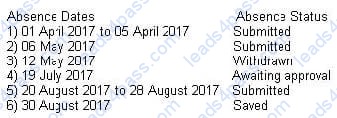
You run the "Evaluate Absence" process with an effective date of 07 April 2017.
Which absences will be processed?
A. 1, 2, 4, 5
B. 1, 4, 5
C. 2, 4, 5, 6
D. 2, 4, 5
E. 4, 5
F. 2, 3, 4, 5, 6





All rights are reserved by
leads4pass.com. Any changes, copy or trademarks abuse will be
regarded as infringement.
leads4pass.com will reserve the right to pursue accountability.
Copyright © 2004-
2026 leads4pass.com.