
1Z0-062 Online Practice Questions and Answers
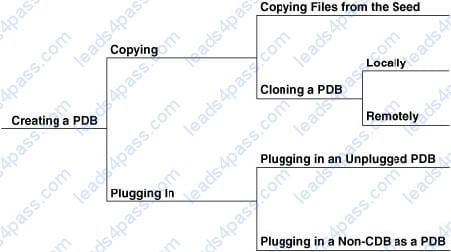
You created a new database using the "create database" statement without specifying the "ENABLE PLUGGABLE" clause.
What are two effects of not using the "ENABLE PLUGGABLE database" clause?
A. The database is created as a non-CDB and can never contain a PDB.
B. The database is treated as a PDB and must be plugged into an existing multitenant container database (CDB).
C. The database is created as a non-CDB and can never be plugged into a CDB.
D. The database is created as a non-CDB but can be plugged into an existing CDB.
E. The database is created as a non-CDB but will become a CDB whenever the first PDB is plugged in.
You plan to migrate your database from a File system to Automata Storage Management (ASM) on same platform.
Which two methods or commands would you use to accomplish this task? (Choose two.)
A. RMAN CONVERT command
B. Data Pump Export and import
C. Conventional Export and Import
D. The BACKUP AS COPY DATABASE . . . command of RMAN
E. DBMS_FILE_TRANSFER with transportable tablespace
You execute the following PL/SQL:
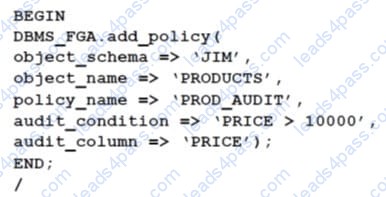
Which two statements are true? (Choose two.)
A. Fine-Grained Auditing (FGA) is enabled for the PRICE column in the PRODUCTS table for SELECT statements only when a row with PRICE > 10000 is accessed.
B. FGA is enabled for the PRODUCTS.PRICE column and an audit record is written whenever a row with PRICE > 10000 is accessed.
C. FGA is enabled for all DML operations by JIM on the PRODUCTS.PRICE column.
D. FGA is enabled for the PRICE column of the PRODUCTS table and the SQL statements is captured in the FGA audit trial.
You are connected using SQL* Plus to a multitenant container database (CDB) with SYSDBA privileges and execute the following sequence statements: What is the result of the last SET CONTAINER statement and why is it so?
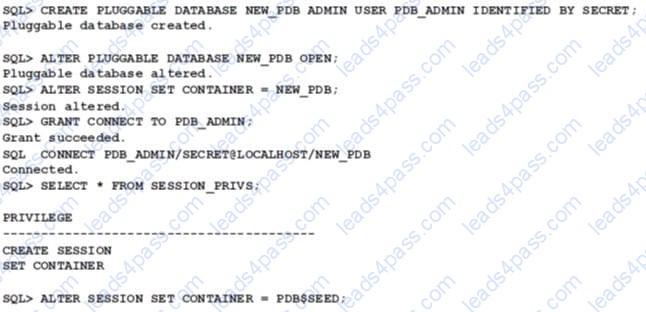
A. It succeeds because the PDB_ADMIN user has the required privileges.
B. It fails because common users are unable to use the SET CONTAINER statement.
C. It fails because local users are unable to use the SET CONTAINER statement.
D. If fails because the SET CONTAINER statement cannot be used with PDB$SEED as the target pluggable database (PDB).
You use the segment advisor to help determine objects for which space may be reclaimed.
Which three statements are true about the advisor given by the segment advisor? (Choose three.)
A. It may advise the use of online table redefinition for tables in dictionary managed tablespace.
B. It may advise the use of segment shrink for tables in dictionary managed tablespaces it the no chained rows.
C. It may advise the use of online table redefinition for tables in locally managed tablespaces
D. It will detect and advise about chained rows.
E. It may advise the use of segment shrink for free list managed tables.
Your multitenant container database, CDB1, is running in ARCHIVELOG mode and has two pluggable databases, HR_PDB and ACCOUNTS_PDB. An RMAN backup exists for the database.
You issue the command to open ACCOUNTS_PDB and find that the USERDATA.DBF data file for the default permanent tablespace USERDATA belonging to ACCOUNTS_PDB is corrupted.
What should you do before executing the commands to restore and recover the data file in ACCOUNTS_PDB?
A. Place CDB1 in the mount stage and then the USERDATA tablespace offline in ACCOUNTS_PDB.
B. Place CDB1 in the mount stage and issue the ALTER PLUGGABLE DATABASE accounts_pdb CLOSE IMMEDIATE command.
C. Issue the ALTER PLUGGABLE DATABASE accounts_pdb RESTRICTED command.
D. Take the USERDATA tablespace offline in ACCOUNTS_PDB.
You want to schedule a job to rebuild a table's indexes after a bulk insert, which must be scheduled as soon as a file containing data arrives on the system.
What would you do to accomplish this?
A. Create a file watcher and an event-based job for bulk insert and then create another job to rebuild indexes on the table.
B. Create a file watcher for the bulk inserts and then create a job to rebuild indexes.
C. Create a job array and add a job for bulk insert and a job to rebuild indexes to the job array.
D. Create an event-based job for the file arrival event, then create a job for bulk insert, and then create a job to rebuild indexes.
You determine that database performance is sub-optimal due to hard parsing statements. Automatic Shared Memory Management (ASMM) is disabled for your database instance.
Which tool would you use to get advice on how to improve performance?
A. Memory Advisor for the PGA
B. SQL Access Advisor
C. Memory Advisor for the shared pool
D. SQL Tuning Advisor
Examine these steps:
CONNECT / AS SYSDBA
CREATE DIRECTORY dumpdir AS '/u01/app/';
Directory created.
GRANT READ, WRITE ON DIRECTORY dumpdir TO PUBLIC;
Grant succeeded.
CREATE USER TEST IDENTIFIED BY test;
User created.
GRANT CREATE SESSION, RESOURCE, UNLIMITED TABLESPACE TO test;
Grant succeeded.
CONN test/test
Connected.
CREATE TABLE test_employees (id NUMBER(3), name VARCHAR2(20), salary NUMBER(7)); Table
created.
SQL> CREATE SYNONYM emp FOR test_employees;
Synonym created.
Now examine this command:
$ expdp test/test DIRECTORY=dumpdir DUMPFILE=test_emp.dmp LOGFILE=test.log TABLES=emp
CONTENT=data_only query='EMP:"WHERE salary=12000"' What is true about the execution of this command?
A. It throws an error as the QUERY parameter is not supported on an empty table.
B. It throws an error as the table test_employees is empty and CONTENT=data_only is specified.
C. It performs the export successfully.
D. It throws an error as Data Pump cannot find a table called TEST.EMP.
A database runs in ARCHIVELOG mode.
Dally full database backups are taken with RMAN which is configured to perform control file autobackup.
The control file and redo log files are multiplexed.
In which two cases is media recovery required? (Choose two.)
A. loss of a data file that belongs to the active undo tablespace
B. physical corruption of data
C. loss of one copy of the control file
D. loss of one member of the active redo log group
E. loss of all members of an inactive redo log group





All rights are reserved by
leads4pass.com. Any changes, copy or trademarks abuse will be
regarded as infringement.
leads4pass.com will reserve the right to pursue accountability.
Copyright © 2004-
2026 leads4pass.com.