
1Z0-060 Online Practice Questions and Answers
Examine the following impdp command to import a database over the network from a pre-12c Oracle database (source):
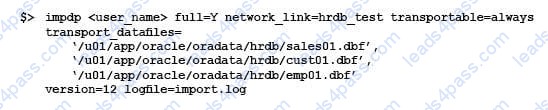
Which three are prerequisites for successful execution of the command? (Choose three.)
A. The import operation must be performed by a user on the target database with the DATAPUMP_IMP_FULL_DATABASE role, and the database link must connect to a user on the source database with the DATAPUMP_EXP_FULL_DATABASE role.
B. All the user-defined tablespaces must be in read-only mode on the source database.
C. The export dump file must be created before starting the import on the target database.
D. The source and target database must be running on the same platform with the same endianness.
E. The path of data files on the target database must be the same as that on the source database.
F. The impdp operation must be performed by the same user that performed the expdp operation.
Examine the following command:

Which three statements are true about using an invisible column in the PRODUCTS table?
A. The %ROWTYPE attribute declarations in PL/SQL to access a row will not display the invisible column in the output.
B. The DESCRIBE commands in SQL *Plus will not display the invisible column in the output.
C. Referential integrity constraint cannot be set on the invisible column.
D. The invisible column cannot be made visible and can only be marked as unused.
E. A primary key constraint can be added on the invisible column.
You are about to plug a multi-terabyte non-CDB into an existing multitenant container database (CDB).
The characteristics of the non-CDB are as follows: Version: Oracle Database 11g Release 2 (11.2.0.2.0) 64-bit Character Set: AL32UTF8 National Character Set: AL16UTF16 O/S: Oracle Linux 6 64-bit
The characteristics of the CDB are as follows: Version: Oracle Database 12c Release 1 64-bit Character Set: AL32UTF8 National Character Set: AL16UTF16 O/S: Oracle Linux 6 64-bit
Which technique should you use to minimize down time while plugging this non-CDB into the CDB?
A. Transportable database
B. Transportable tablespace
C. Data Pump full export/import
D. The DBMS_PDB package
E. RMAN
You notice a performance change in your production Oracle database and you want to know which change has made this performance difference.
You generate the Compare Period Automatic Database Diagnostic Monitor (ADDM) report to further investigation.
Which three findings would you get from the report?
A. It detects any configuration change that caused a performance difference in both time periods.
B. It identifies any workload change that caused a performance difference in both time periods.
C. It detects the top wait events causing performance degradation.
D. It shows the resource usage for CPU, memory, and I/O in both time periods.
E. It shows the difference in the size of memory pools in both time periods.
F. It gives information about statistics collection in both time periods.
You notice that the elapsed time for an important database scheduler Job is unacceptably long.
The job belongs to a scheduler job class and runs in a scheduler window.
Which two actions could reduce the job's elapsed time?
A. increasing the priority of the job class to which the job belongs
B. increasing the job's relative priority within the job class to which it belongs
C. increasing resource allocation for the consumer group mapped to the job class in the resource manager plan associated with the scheduler window
D. moving the job to an existing higher priority scheduler window with the same schedule and duration
E. increasing the value of the JOB_QUEUE_PROCESSES parameter
F. increasing the priority of the scheduler window to which the job belongs
A senior DBA asked you to execute the following command to improve performance:

You checked the data in the SUBSCRIBE_LOG table and found that it is a large table containing one million rows.
What could be a reason for this recommendation?
A. The keep pool is not configured.
B. Automatic Workarea Management is not configured.
C. Automatic Shared Memory Management is not enabled.
D. The data blocks in the SUBSCRIBE_LOG table are rarely accessed.
E. All the queries on the SUBSCRIBE_LOG table are rewritten to a materialized view.
Which two statements are true regarding SQL*Loader Express Mode in an Oracle 12c database? (Choose two.)
A. You cannot have multiple SQL*Loader data files.
B. The DEGREE_OF_PARALLELISM parameter is set to AUTO.
C. If no data file is specified, it uses table-name.dat and assumes it is in the current directory.
D. A new table is created and data is inserted into the table if it does not exist in a schema.
While investigating a possible security breach, you realized that some audit records were not retrieved when the UNIFIED_AUDIT_TRAIL view was queried.
How can you ensure that all available audit records are returned when the audit trail is queried?
A. Query the v$UNIFIED_AUDIT_TRAIL view rather than the UNIFIED_AUDIT_TRAIL view.
B. Enable the OS auditing option in the database before querying the UNIFIED_AUDIT_TRAIL view.
C. Configure the IMMEDIATE write mode using the DBMS_AUDIT_MGMT.SET_AUDIT_TRAIL view.
D. Execute the DBMS_AUDIT_MGMT.FLUSH_INIFIED_AUDIT_TRAIL procedure before querying the UNIFIED_AUDIT_TRAIL view.
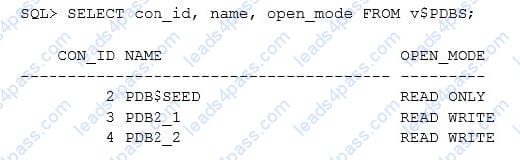
Your multitenant container database (CDB) is running in ARCHIVELOG mode.
Examine this command and its output:
You issue this command in RMAN:
RMAN>BACKUP PLUGGABLE DATABASE "CDB$ROOT", pdb2_1;
What is the outcome?
A. The backup succeeds, but only the SYSTEM and SYSAUX tablespaces in the root container are backed up along with all the data files in PDB2_1.
B. The backup fails because the root container cannot be backed up with PDB2_1.
C. The backup succeeds and all the data files belonging to both the root container and PDB2_1 are backed up.
D. The backup fails because PDB2_1 should be placed in the mount stage.
Which action takes place when an incremental checkpoint occurs?
A. The checkpoint position is advanced by the checkpoint process.
B. Redo entries are written by the checkpoint process to the online redo log files.
C. All dirty buffers are written to data files by the checkpoint process.
D. The checkpoint position is written to all the data file headers and the control file by the checkpoint process.
E. The checkpoint position is written to the control file by the checkpoint process.





All rights are reserved by
leads4pass.com. Any changes, copy or trademarks abuse will be
regarded as infringement.
leads4pass.com will reserve the right to pursue accountability.
Copyright © 2004-
2026 leads4pass.com.