
1Z0-034 Online Practice Questions and Answers
What happens when you run the SQL Tuning Advisor with limited scope?
A. Access path analysis is not performed for SQL statements.
B. SQL structure analysis is not performed for SQL statements.
C. SQL Profile recommendations are not generated for SQL statements.
D. Staleness and absence of statistics are not checked for the objects in the query supplied to the SQL Tuning Advisor.
The DB_BLOCK_CHECKING parameter is set to FULL. What checks occur each time the DBWnprocess(es) writes?
A. The Oracle database will check all data blocks by going through the data on each block, making sure the data is self-consistent.
B. The DBWn and the direct loader will calculate a checksum and store it in the cache header of every data block when writing it to disk.
C. The Oracle database will check data blocks belonging to the SYSTEM tablespace only, by going through the data on each block, making sure the data is self-consistent.
D. The Oracle database will check data blocks belonging to the SYSAUX tablespace only, by going through the data on each block, making sure the data is self-consistent.
E. The Oracle database will check data blocks in the SYSTEM and SYSAUX tablespaces only, by going through the data on each block, making sure the data is self-consistent.
View the following SQL statements: Transaction T1
SQL> INSERT INTO hr.regions 2 VALUES (5,'Pole'); 3 COMMIT;
Transaction T2
SQL> UPDATE hr.regions 2 SET region_name='Poles' 3 WHERE region_id = 5; 4 COMMIT;
Transaction T3
SQL> UPDATE hr.regions 2 SET region_name='North and South Poles' 3 WHERE region_id = 5;
You want to back out transaction T2. Which option would you use?
A. It is possible, but transaction T3 also backs out.
B. It is possible with the NOCASCADE_FORCE option.
C. It is possible with the NONCONFLICT_ONLY option.
D. It is not possible because it has conflicts with transaction T3.
Which statement is true about a running session that belongs to the online transaction processing (OLTP) group?
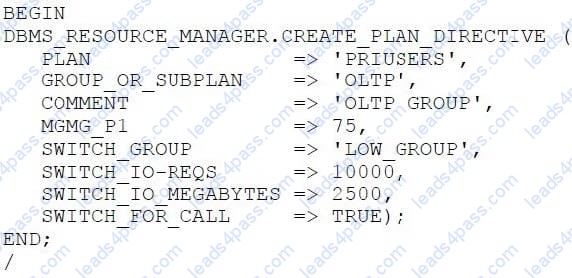
A. It permanently switches to the low_group consumer group if the session exceeds 10,000 I/O requests or 2,500 MB of data transfer.
B. It performs the first 10000 I/O requests or 2,500 MB of data transfer in the LOW-GROUP consumer group, and then switches to the original group.
C. It switches to the LOW_GROUP consumer group if the session exceeds 10000 I/O requests or 2500 MB of data transfer and returns to the original group after the operation.
D. It switches to the LOW_GROUP consumer group if the session exceeds 10000 I/O requests or 2500 MB of data transfer for queries, but not for data manipulation language (DML) operations.
You have specified the warning and critical threshold values of an application tablespace to be 60% and 70% respectively.
From the tablespace space usage metrics, you find that the actual space usage has reached the specified warning threshold value, but no alerts have been generated. What could be the reason for this?
A. The EVEN parameter was not set.
B. The SQL_TRACE parameter is set to FALSE.
C. Enterprise Manager is not used.
D. The STATISTICS_LEVEL parameter is set to BASIC.
E. The TIMED_STATISTICS parameter is set to FALSE.
Which two statements are true regarding hot patching? (Choose two.)
A. It requires relinking of the Oracle binary.
B. It does not require database instance shutdown.
C. It can detect conflicts between two online patches.
D. It is available for installing all patches on all platforms.
E. It works only in a single database instance environment.
In which two aspects does hot patching differ from conventional patching? (Choose two.)
A. It consumes more memory compared with conventional patching.
B. It can be installed and uninstalled via OPatch unlike conventional patching.
C. It takes more time to install or uninstall compared with conventional patching.
D. It does not require down time to apply or remove unlike conventional patching.
E. It is not persistent across instance startup and shutdown unlike conventional patching.
You have enabled backup optimization for the RMAN environment. Identify two criteria on which RMAN will skip the file, if it has already been backed up.
A. The data file backup is done with multiple channels
B. The data files is in the read-write mode after being backed up in the read only mode
C. The backup was taken after the data files was taken offline-normal or is in the read only mode
D. The data file backup complies with the back retention policy and the backup duplexing feature
To accomplish user-managed backup for the USERS tablespace, you issued the following command to put
the tablespace in backup mode:
SQL> ALTER TABLESPACE users BEGIN BACKUP;
While copying the file to the backup destination a power outage caused the instance to terminate
abnormally.
Which statement is true about the next database startup and the userstablespace?
A. The database will open, and the tablespace automatically comes out of the backup mode.
B. The database will be mounted, and recovery must be performed on the USERS tablespace.
C. The database will be mounted, and data files in the USERS tablespace must be taken out of the backup mode.
D. The database will not be mounted, and you must restore all the data files for the USERS tablespace from the backup, and perform recovery.
In which two situations would you rebuild an index using the ALTER INDEX----- REBUILD command?
A. to change a unique index into a non-unique index
B. to change index storage options
C. to enable index monitoring
D. to move the index to another tablespace
E. to improve performance of an INDEX CLUSTER





All rights are reserved by
leads4pass.com. Any changes, copy or trademarks abuse will be
regarded as infringement.
leads4pass.com will reserve the right to pursue accountability.
Copyright © 2004-
2026 leads4pass.com.