
1D0-437 Online Practice Questions and Answers
Consider the following lines of code:
sub mySub { (
$arg, @args) = @_;
foreach $val (@args) {
$returnVal .= "$arg, $val\n";
}
$returnVal . "" . @args;
}
print andmySub(1, "a value", "another value", "a parameter", "another parameter"); What is the output of
these lines of code?
A. 1, a value 1, another value 1, a parameter 1, another parameter 4
B. 1, a value 1, another value 1, a parameter 1, another parameter a valueanother valuea parameteranother parameter
C. 1, a value, another value, a parameter, another parameter a value another value a parameter another parameter
D. 1, a value, another value, a parameter, another parameter 4
Consider the following program code:
print(1 );
BEGIN { print(2 ); }
END { print(3 ); }
BEGIN { print(4 ); }
END
{
package MyPackage;
print(5 );
}
What is the result of executing this program code?
A. The code will output the following: 1 2 3 4 5
B. The code will output the following: 2 4 1 5 3
C. The code will output the following: 2 1 3 4 5
D. The code will output the following: 2 4 1 3
Which one of the following statements uses correct syntax and expressions?
A. do (print "Hello $a") until ($a = 10);
B. do {$a++} until {$a == $b}\;
C. do {$in = $in++} while ($in < 100);
D. do ($a++) until ($b = $a);
Consider the following program code:
@array = ("ALPHA", "beta", "GaMmA");
sort(@array);
print("@array");
What is the output of this code?
A. beta GaMmA ALPHA
B. ALPHA GaMmA beta
C. ALPHA beta GaMmA
D. beta ALPHA GaMmA
Consider the following program code:
$Animal = Dogs bark;
package Cat;
$Animal = Cats purr;
{
package Fish;
$Animal = Fish swim;
}
package main;
print $Animal;
What is the result of executing this program code?
A. The code will fail at line 4.
B. The code will output the following: Dogs bark
C. The code will output the following: Cats purr
D. The code will output the following: Fish swim
Consider the following program code:
@array = ("ALPHA", "beta", "GaMmA");
@array = sort(@array);
print("@array");
What is the output of this code?
A. beta GaMmA ALPHA
B. ALPHA GaMmA beta
C. ALPHA beta GaMmA
D. beta ALPHA GaMmA
Running your Perl scripts with a d switch will perform which task?
A. Invoke the Perl debugger
B. Send standard error to a file
C. Disable breakpoints
D. Display a stack trace
Consider the following program code:
$x = 150;
$y = "250";
if (($x + 100) == $y) { print("1 "); }
if ("250" == $y) { print("2 "); }
if ("250" eq $y) { print("3 "); }
if ($x lt $y) { print("4 "); }
if ($x ge $y) { print("5 "); }
What is the result of executing this program code?
A. The code will output the following: 1 2 3 4
B. The code will output the following: 1 3 4
C. The code will output the following: 1 3 5
D. The code will output the following: 1 2 3 4 5
Consider the program code in the attached exhibit.
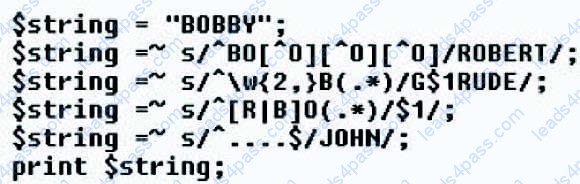
What is the result of executing this program code?
A. The code will output the following: BOBBY
B. The code will output the following: GERTRUDE
C. The code will output the following: JOHN
D. The code will output the following: ROBERT
Consider the following command:
perl runme.pl arg1 arg2 arg3
Given this command issued on the command line, what is the value of @ARGV?
A. arg1
B. runme.pl
C. arg1 arg2 arg3
D. 2





All rights are reserved by
leads4pass.com. Any changes, copy or trademarks abuse will be
regarded as infringement.
leads4pass.com will reserve the right to pursue accountability.
Copyright © 2004-
2026 leads4pass.com.